Stele Forest Museum
⭐ 4.60
Stele Forest Museum, Beilin District, Xi'an, Shaanxi Province, China
 **A Millennium of Stone and Scholarship**
Founded in 1087 during the Song dynasty as a repository for Tang-era stone classics, the Beilin Museum has grown over nine centuries into a singular cultural treasure. Its setting atop the original Confucian temple of Xi'an—itself dating to the late Tang—makes it one of China's best-preserved examples of Confucian ceremonial architecture, much as the Temple of Confucius in Qufu preserves an older imperial ritual complex. The site's triadic layout of "temple, academy, and stele forest" reflects the ancient Chinese ideal that education, ritual, and historical memory belong together under one roof, a concept reminiscent of Europe's medieval cathedral schools where learning was inseparable from sacred space.
**The Stone Library's Treasures**
At the heart of the collection stands the Kaicheng Stone Classics, a 114-stone anthology carved in 837 AD that transcribes the entire Confucian canon—over 650,000 characters—into stone. Think of it as the Chinese equivalent of Trajan's Column inscriptions magnified a hundredfold: an entire civilization's foundational texts preserved not on papyrus or vellum, but in granite meant to outlast empires. Equally compelling is the Nestorian Stele of 781 AD, which documents the arrival of Syriac Christianity along the Silk Road and ranks among the world's four most celebrated epigraphic monuments, alongside the Rosetta Stone and Behistun Inscription.
**Calligraphy Carved in Stone**
For anyone interested in the visual arts, Beilin functions as a chronological gallery of Chinese calligraphy—from ancient seal script through the bold brushwork of masters like Yan Zhenqing and Liu Gongquan, whose influence on East Asian script parallels that of Garamond or Bodoni on European typography. The museum also preserves four original reliefs of the "Six Steeds of Zhaoling," Tang Taizong's beloved war horses, masterworks of 7th-century sculpture that echo the narrative reliefs of Trajan's Column while expressing a uniquely Tang sensibility of power and grace.
**Architecture and Atmosphere**
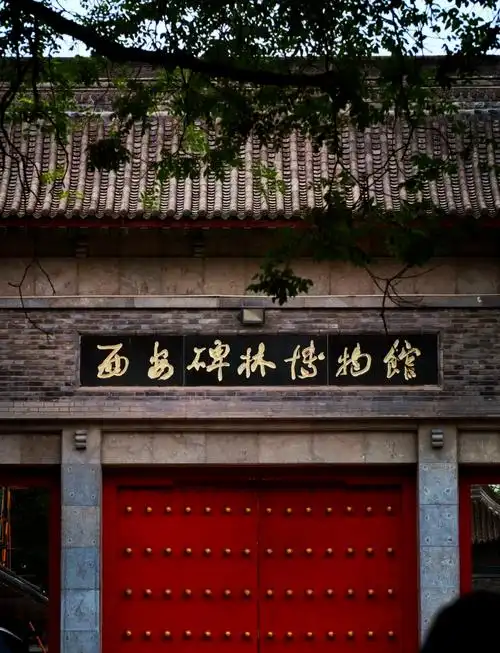
The museum unfolds along a traditional north-south axis, passing through ceremonial gates, the Lingxing Gate, and the grand Dacheng Hall before reaching the seven stele galleries, eight covered corridors, and eight pavilions that shelter the collection. The Ming and Qing official architectural style has been carefully preserved, with weathered cypress beams, glazed roof tiles, and stone-paved courtyards offering a contemplative atmosphere akin to wandering through an Oxford college quadrangle—quiet, scholarly, and steeped in the patina of countless generations of literati who came here to study and admire.
**Practical Information for Visitors**
Located at 15 Sanxue Street inside the Wenchang Gate in Xi'an's Beilin District, the museum is easily reached via Metro Line 2 (Yongningmen Station) or Line 4 (Hepingmen Station). Admission is approximately 85 RMB, with advance online booking required and ID necessary for entry. Opening hours run 9:00 to 17:30, extending to 19:00 during summer months. Plan to spend at least two and a half to three and a half hours—rushing through would mean missing the museum's quieter pleasures.
**Why It Belongs on Your Itinerary**
Xi'an already tempts travelers with the Terracotta Army and the old city walls, but Beilin offers something rarer: an intimate encounter with the texts and aesthetic traditions that shaped Chinese civilization for two thousand years. With an audio guide or a specialist docent, ordinary tourists can decode inscriptions that emperors, scholars, and monks once revered. For Western visitors accustomed to the parchment libraries of Europe or the inscribed monuments of Rome, Beilin reveals that China's equivalent masterpieces were not painted on scrolls alone—they were carved to endure forever, and they still do.
**A Millennium of Stone and Scholarship**
Founded in 1087 during the Song dynasty as a repository for Tang-era stone classics, the Beilin Museum has grown over nine centuries into a singular cultural treasure. Its setting atop the original Confucian temple of Xi'an—itself dating to the late Tang—makes it one of China's best-preserved examples of Confucian ceremonial architecture, much as the Temple of Confucius in Qufu preserves an older imperial ritual complex. The site's triadic layout of "temple, academy, and stele forest" reflects the ancient Chinese ideal that education, ritual, and historical memory belong together under one roof, a concept reminiscent of Europe's medieval cathedral schools where learning was inseparable from sacred space.
**The Stone Library's Treasures**
At the heart of the collection stands the Kaicheng Stone Classics, a 114-stone anthology carved in 837 AD that transcribes the entire Confucian canon—over 650,000 characters—into stone. Think of it as the Chinese equivalent of Trajan's Column inscriptions magnified a hundredfold: an entire civilization's foundational texts preserved not on papyrus or vellum, but in granite meant to outlast empires. Equally compelling is the Nestorian Stele of 781 AD, which documents the arrival of Syriac Christianity along the Silk Road and ranks among the world's four most celebrated epigraphic monuments, alongside the Rosetta Stone and Behistun Inscription.
**Calligraphy Carved in Stone**
For anyone interested in the visual arts, Beilin functions as a chronological gallery of Chinese calligraphy—from ancient seal script through the bold brushwork of masters like Yan Zhenqing and Liu Gongquan, whose influence on East Asian script parallels that of Garamond or Bodoni on European typography. The museum also preserves four original reliefs of the "Six Steeds of Zhaoling," Tang Taizong's beloved war horses, masterworks of 7th-century sculpture that echo the narrative reliefs of Trajan's Column while expressing a uniquely Tang sensibility of power and grace.
**Architecture and Atmosphere**
The museum unfolds along a traditional north-south axis, passing through ceremonial gates, the Lingxing Gate, and the grand Dacheng Hall before reaching the seven stele galleries, eight covered corridors, and eight pavilions that shelter the collection. The Ming and Qing official architectural style has been carefully preserved, with weathered cypress beams, glazed roof tiles, and stone-paved courtyards offering a contemplative atmosphere akin to wandering through an Oxford college quadrangle—quiet, scholarly, and steeped in the patina of countless generations of literati who came here to study and admire.
**Practical Information for Visitors**
Located at 15 Sanxue Street inside the Wenchang Gate in Xi'an's Beilin District, the museum is easily reached via Metro Line 2 (Yongningmen Station) or Line 4 (Hepingmen Station). Admission is approximately 85 RMB, with advance online booking required and ID necessary for entry. Opening hours run 9:00 to 17:30, extending to 19:00 during summer months. Plan to spend at least two and a half to three and a half hours—rushing through would mean missing the museum's quieter pleasures.
**Why It Belongs on Your Itinerary**
Xi'an already tempts travelers with the Terracotta Army and the old city walls, but Beilin offers something rarer: an intimate encounter with the texts and aesthetic traditions that shaped Chinese civilization for two thousand years. With an audio guide or a specialist docent, ordinary tourists can decode inscriptions that emperors, scholars, and monks once revered. For Western visitors accustomed to the parchment libraries of Europe or the inscribed monuments of Rome, Beilin reveals that China's equivalent masterpieces were not painted on scrolls alone—they were carved to endure forever, and they still do.