Qujiang Pool Ruins Park
⭐ 4.60
Qujiang Pool Ruins Park, Yanta District, Xi'an, Shaanxi, China
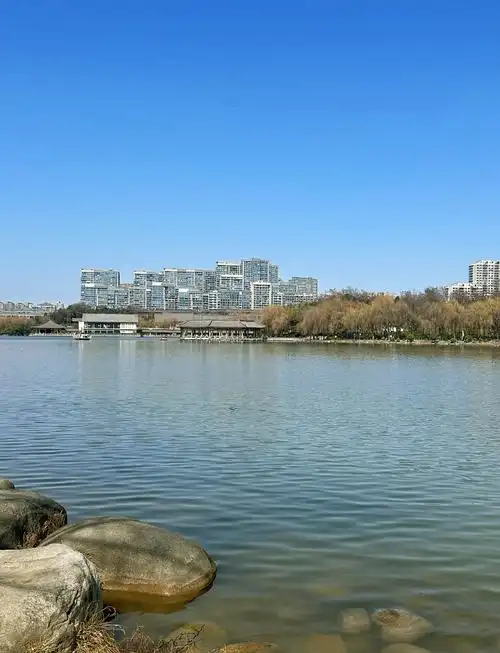 During the Tang Dynasty (618–907 CE), Chang'an stood as the world's largest and most cosmopolitan metropolis, rivaling contemporary Constantinople and Baghdad in size and grandeur. Qujiang Pool, originally laid out under the Qin and Han, became the empire's premier royal pleasure ground—a status roughly comparable to the imperial hunting forests of Versailles or the pleasure gardens of Mughal Agra. The newly minted jinshi scholars held their celebratory banquets here, and Tang literati immortalized the spot as one of the "Eight Scenes of Guanzhong." The pool silted up after late-Tang warfare and lay forgotten until the celebrated architect Zhang Jinqiu led a modern restoration that revived the original lakeside axis.
The park's eight scenic zones, including the imposing Yuejiang Tower and the misty Yanbo Island, are unified by Tang architectural vocabulary—sweeping tiled roofs, vermilion columns, and generous eaves recalling a 1,300-year-old aesthetic. The 2-3 km flat, barrier-free lakeside loop connects each zone through a sequence of more than thirty bronze sculpture groups, which capture scenes such as poets reclining in cups of wine floating on the water, ladies bathing, and Sogdian merchants haggling. Many pavilions take their names from ci poetry titles, weaving literary allusions directly into the built environment—a Tang sensibility that anticipates the literary gardens of Edo Japan.
Culturally, the park offers visitors an accessible window onto the Tang golden age, when China led the world in poetry, painting, and urban planning. The juxtaposition of imperial grandeur with everyday vignettes—the drinking scholars, the street vendors—mirrors the cosmopolitan layering of cities like Renaissance Florence or Ottoman Istanbul. It also forms a cultural anchor for the surrounding Tang-themed developments, providing context that most modern reconstructions cannot match.
The park is open daily and free of charge, with level walking paths suitable for strollers and wheelchairs. The best season is summer, when June through August brings lotus blossoms, and evenings offer illuminated views across the water. Paid options include paddle boats and electric shuttle carts. Plan to arrive after 4 PM to enjoy both golden-hour light and the lantern-lit夜色; combining the visit with the neighboring Tang Paradise and the Grand Tang Mall creates a seamless full-day immersion into Tang Dynasty splendor.
What makes Qujiang Pool worth the detour is its rarity: a genuinely ancient site—rebuilt, yes, but laid out on the bones of an 1,100-year-old imperial landscape—where the poetry of Li Bai and Du Fu still seems to hang in the evening air. Few places on earth allow you to stroll the shoreline of a vanished Tang capital so close to the heart of a modern Chinese metropolis.
During the Tang Dynasty (618–907 CE), Chang'an stood as the world's largest and most cosmopolitan metropolis, rivaling contemporary Constantinople and Baghdad in size and grandeur. Qujiang Pool, originally laid out under the Qin and Han, became the empire's premier royal pleasure ground—a status roughly comparable to the imperial hunting forests of Versailles or the pleasure gardens of Mughal Agra. The newly minted jinshi scholars held their celebratory banquets here, and Tang literati immortalized the spot as one of the "Eight Scenes of Guanzhong." The pool silted up after late-Tang warfare and lay forgotten until the celebrated architect Zhang Jinqiu led a modern restoration that revived the original lakeside axis.
The park's eight scenic zones, including the imposing Yuejiang Tower and the misty Yanbo Island, are unified by Tang architectural vocabulary—sweeping tiled roofs, vermilion columns, and generous eaves recalling a 1,300-year-old aesthetic. The 2-3 km flat, barrier-free lakeside loop connects each zone through a sequence of more than thirty bronze sculpture groups, which capture scenes such as poets reclining in cups of wine floating on the water, ladies bathing, and Sogdian merchants haggling. Many pavilions take their names from ci poetry titles, weaving literary allusions directly into the built environment—a Tang sensibility that anticipates the literary gardens of Edo Japan.
Culturally, the park offers visitors an accessible window onto the Tang golden age, when China led the world in poetry, painting, and urban planning. The juxtaposition of imperial grandeur with everyday vignettes—the drinking scholars, the street vendors—mirrors the cosmopolitan layering of cities like Renaissance Florence or Ottoman Istanbul. It also forms a cultural anchor for the surrounding Tang-themed developments, providing context that most modern reconstructions cannot match.
The park is open daily and free of charge, with level walking paths suitable for strollers and wheelchairs. The best season is summer, when June through August brings lotus blossoms, and evenings offer illuminated views across the water. Paid options include paddle boats and electric shuttle carts. Plan to arrive after 4 PM to enjoy both golden-hour light and the lantern-lit夜色; combining the visit with the neighboring Tang Paradise and the Grand Tang Mall creates a seamless full-day immersion into Tang Dynasty splendor.
What makes Qujiang Pool worth the detour is its rarity: a genuinely ancient site—rebuilt, yes, but laid out on the bones of an 1,100-year-old imperial landscape—where the poetry of Li Bai and Du Fu still seems to hang in the evening air. Few places on earth allow you to stroll the shoreline of a vanished Tang capital so close to the heart of a modern Chinese metropolis.