Bell Tower
⭐ 3.80
Bell Tower Scenic Area, Fengyang County, Chuzhou City, Anhui Province, China
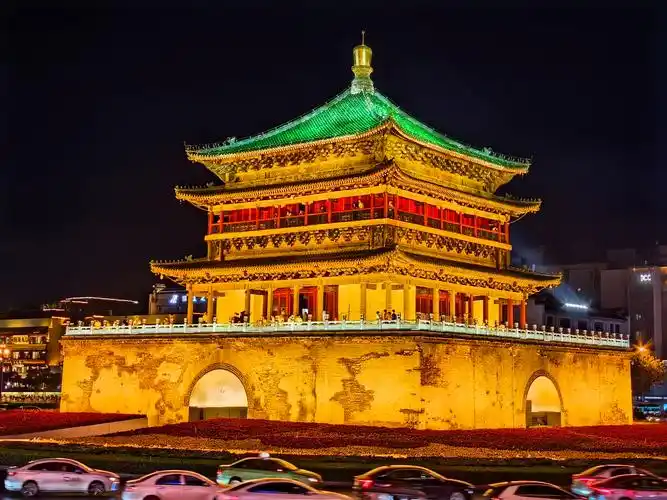 Rising in 1375 during the eighth year of the Hongwu reign, the original Bell Tower served as the ceremonial centerpiece of "Imperial Central Capital" (Zhongdu), a grand capital project launched by the Ming founding emperor Zhu Yuanzhang. The scheme rivaled in ambition Europe's grand absolutist foundations—think Louis XIV's Versailles or Peter the Great's St. Petersburg—but was abandoned after the emperor shifted his seat first to Nanjing, then to Beijing. The tower itself perished in later conflicts until a meticulous 2018 reconstruction, completed with original Ming specifications and opened in 2021, restored it as Fengyang's flagship cultural monument.
The tower follows the most exalted "nine-five bay" configuration—a layout normally reserved for imperial palaces and never before applied to a single bell tower in Chinese architecture. Its 32.8-meter timber-frame body rises from a broad stone platform reaching a total of 40.1 meters, a verticality that would sit comfortably alongside Big Ben in London or the Campanile of St. Mark's in Venice. Within hangs a colossal bronze bell weighing 36 tons and standing 5.28 meters tall, cast in classical style and celebrated for its deep, resonant tone.
Paired across the old city axis with the Drum Tower to the east, the Bell Tower revives the ancient Chinese ideal of "morning bell, evening drum"—the ritual heartbeat of imperial statecraft. Its interior exhibitions walk visitors through the cosmological symbolism of bells in Chinese tradition, the strict hierarchies of Ming court dress, and the etiquette of court ceremonial life. The reconstruction is both cultural preservation and city branding, breathing renewed life into a capital that history nearly forgot.
Located at the western end of Yunji Street in Fengyang County, roughly 45 kilometers from downtown Chuzhou, the site is best reached by private car or ride-hailing; an underground parking lot is available. Entry starts at around 30 yuan and includes basic guiding, with smart audio guides rentable onsite. Foreign visitors should carry their passport and are advised to call ahead to arrange English-language interpretation. The surrounding plaza opens free at certain hours, making a brief stop easy for passing travelers.
For an ideal half-day, climb the tower at opening for sweeping views, then walk east to the Drum Tower to experience the symmetrical Ming-era layout, and continue along the historic axis to the Ming Zhongdu Relics Park, where palace wall remnants and gate platforms still survive. Photographers will find soft morning and late-afternoon light most flattering, while hanfu enthusiasts flock here for classical backdrops. Wear flat non-slip shoes for the internal staircases, and bring sun protection and plenty of water during the hot summer months.
Rising in 1375 during the eighth year of the Hongwu reign, the original Bell Tower served as the ceremonial centerpiece of "Imperial Central Capital" (Zhongdu), a grand capital project launched by the Ming founding emperor Zhu Yuanzhang. The scheme rivaled in ambition Europe's grand absolutist foundations—think Louis XIV's Versailles or Peter the Great's St. Petersburg—but was abandoned after the emperor shifted his seat first to Nanjing, then to Beijing. The tower itself perished in later conflicts until a meticulous 2018 reconstruction, completed with original Ming specifications and opened in 2021, restored it as Fengyang's flagship cultural monument.
The tower follows the most exalted "nine-five bay" configuration—a layout normally reserved for imperial palaces and never before applied to a single bell tower in Chinese architecture. Its 32.8-meter timber-frame body rises from a broad stone platform reaching a total of 40.1 meters, a verticality that would sit comfortably alongside Big Ben in London or the Campanile of St. Mark's in Venice. Within hangs a colossal bronze bell weighing 36 tons and standing 5.28 meters tall, cast in classical style and celebrated for its deep, resonant tone.
Paired across the old city axis with the Drum Tower to the east, the Bell Tower revives the ancient Chinese ideal of "morning bell, evening drum"—the ritual heartbeat of imperial statecraft. Its interior exhibitions walk visitors through the cosmological symbolism of bells in Chinese tradition, the strict hierarchies of Ming court dress, and the etiquette of court ceremonial life. The reconstruction is both cultural preservation and city branding, breathing renewed life into a capital that history nearly forgot.
Located at the western end of Yunji Street in Fengyang County, roughly 45 kilometers from downtown Chuzhou, the site is best reached by private car or ride-hailing; an underground parking lot is available. Entry starts at around 30 yuan and includes basic guiding, with smart audio guides rentable onsite. Foreign visitors should carry their passport and are advised to call ahead to arrange English-language interpretation. The surrounding plaza opens free at certain hours, making a brief stop easy for passing travelers.
For an ideal half-day, climb the tower at opening for sweeping views, then walk east to the Drum Tower to experience the symmetrical Ming-era layout, and continue along the historic axis to the Ming Zhongdu Relics Park, where palace wall remnants and gate platforms still survive. Photographers will find soft morning and late-afternoon light most flattering, while hanfu enthusiasts flock here for classical backdrops. Wear flat non-slip shoes for the internal staircases, and bring sun protection and plenty of water during the hot summer months.