Xi'an City Wall and Beilin Historical Culture
⭐ 4.20
Xi'an City Wall · Beilin Historical and Cultural Scenic Area, Sanxue Street No. 15, Beilin District, Xi'an City, Shaanxi Province, China
 **Historical Context**
Xi'an's City Wall rose to its current form in 1370, built atop the foundations of the Tang Dynasty imperial precinct, making it roughly contemporary with the great European fortifications of the Hundred Years' War era—think of it as China's answer to Carcassonne, though far larger and still ringed by bustling streets. The Beilin Museum traces its origins to 1087, when scholars began preserving sacred Confucian texts in stone; over nine centuries, it accumulated a "library carved in rock" containing more than 4,000 steles. Both sites have witnessed the rise and fall of thirteen dynasties that made Xi'an (ancient Chang'an) the most cosmopolitan city on Earth during the 8th century, when its population dwarfed that of contemporary Rome or Baghdad.
**Architecture**
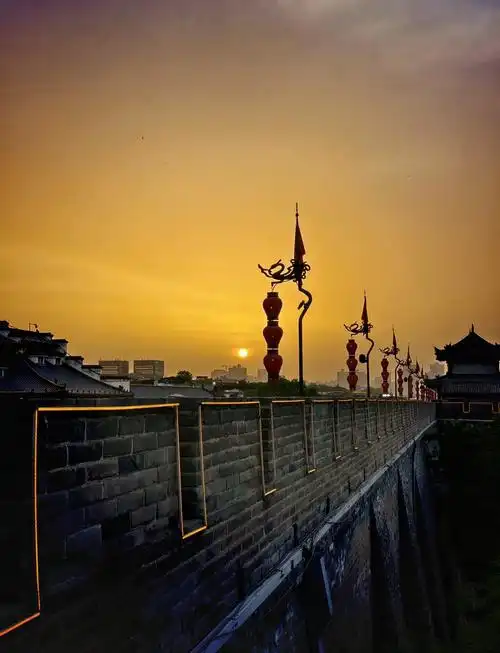
The wall stands 12 meters tall with a walkway 12–14 meters wide—wide enough to drive a cart along, just as soldiers once did. Eighteen battle towers, four fortified gate complexes, and the legendary Yongning and Anding gates remain intact, showcasing the pinnacle of late imperial military engineering. Inside the Beilin complex, the temple-hall pavilions with their sweeping eaves bracket-and-block roof systems echo the elegance of Gothic cathedral cloisters, framing courtyards filled with stone masters whose inscriptions span over two millennia.
**Cultural Significance**
The Beilin preserves calligraphy by titans like Yan Zhenqing and Liu Gongquan—figures who shaped East Asian script the way Italian humanists shaped Western lettering—alongside four of the original six "Six Steeds of Zhaoling," Tang Dynasty reliefs often compared to the Parthenon marbles for their artistic vitality. The collection of the *Kaicheng Stone Classics*, a complete Confucian canon carved in stone, served as China's exam-prep template for centuries. Combined with the wall's silent testimony to urban planning that still dictates Xi'an's grid, the two sites form a three-dimensional textbook of Chinese civilization.
**Practical Visit Information**
Located in central Xi'an with excellent metro and bus access, both attractions share a convenient entry through Wenchang Gate, where you can transition seamlessly between them. The wall offers bicycle rentals—a leisurely full circuit takes 1.5 to 2 hours—while the Beilin is an indoor, climate-controlled experience ideal for unhurried study. Combo tickets offer excellent value; guided tours or audio guides in English are strongly recommended to unlock the stories behind the carvings.
**Why Visit**
Few places on Earth let you cycle atop 600-year-old battlements at sunset, then wander a museum where a Confucian scholar's brushstrokes survive on a stone slab from the year 837—just two stops from today's soulless high-speed rail stations. For travelers seeking to grasp the depth of Chinese civilization beyond the iconic Terracotta Army, this pairing offers the most concentrated, walkable immersion available.
**Historical Context**
Xi'an's City Wall rose to its current form in 1370, built atop the foundations of the Tang Dynasty imperial precinct, making it roughly contemporary with the great European fortifications of the Hundred Years' War era—think of it as China's answer to Carcassonne, though far larger and still ringed by bustling streets. The Beilin Museum traces its origins to 1087, when scholars began preserving sacred Confucian texts in stone; over nine centuries, it accumulated a "library carved in rock" containing more than 4,000 steles. Both sites have witnessed the rise and fall of thirteen dynasties that made Xi'an (ancient Chang'an) the most cosmopolitan city on Earth during the 8th century, when its population dwarfed that of contemporary Rome or Baghdad.
**Architecture**
The wall stands 12 meters tall with a walkway 12–14 meters wide—wide enough to drive a cart along, just as soldiers once did. Eighteen battle towers, four fortified gate complexes, and the legendary Yongning and Anding gates remain intact, showcasing the pinnacle of late imperial military engineering. Inside the Beilin complex, the temple-hall pavilions with their sweeping eaves bracket-and-block roof systems echo the elegance of Gothic cathedral cloisters, framing courtyards filled with stone masters whose inscriptions span over two millennia.
**Cultural Significance**
The Beilin preserves calligraphy by titans like Yan Zhenqing and Liu Gongquan—figures who shaped East Asian script the way Italian humanists shaped Western lettering—alongside four of the original six "Six Steeds of Zhaoling," Tang Dynasty reliefs often compared to the Parthenon marbles for their artistic vitality. The collection of the *Kaicheng Stone Classics*, a complete Confucian canon carved in stone, served as China's exam-prep template for centuries. Combined with the wall's silent testimony to urban planning that still dictates Xi'an's grid, the two sites form a three-dimensional textbook of Chinese civilization.
**Practical Visit Information**
Located in central Xi'an with excellent metro and bus access, both attractions share a convenient entry through Wenchang Gate, where you can transition seamlessly between them. The wall offers bicycle rentals—a leisurely full circuit takes 1.5 to 2 hours—while the Beilin is an indoor, climate-controlled experience ideal for unhurried study. Combo tickets offer excellent value; guided tours or audio guides in English are strongly recommended to unlock the stories behind the carvings.
**Why Visit**
Few places on Earth let you cycle atop 600-year-old battlements at sunset, then wander a museum where a Confucian scholar's brushstrokes survive on a stone slab from the year 837—just two stops from today's soulless high-speed rail stations. For travelers seeking to grasp the depth of Chinese civilization beyond the iconic Terracotta Army, this pairing offers the most concentrated, walkable immersion available.