Terracotta Army Museum
⭐ 4.70
Terracotta Army Museum, Lintong District, Xi'an, Shaanxi Province, China
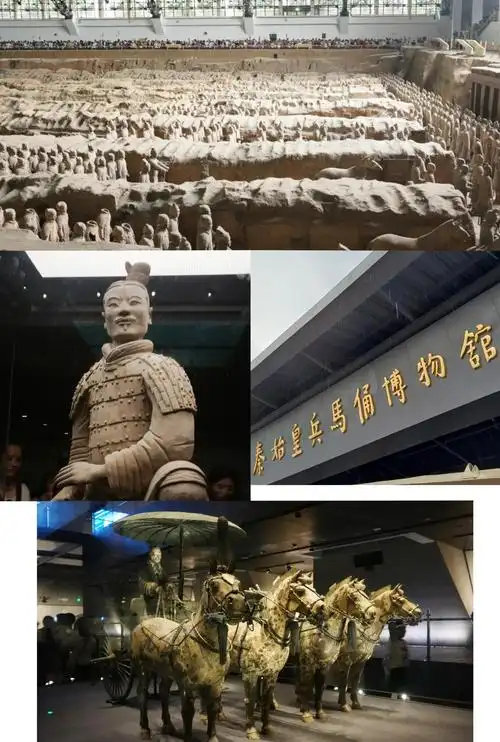 The Terracotta Army was created between 246 and 208 BCE to guard the tomb of Qin Shi Huang, China's first emperor, who unified warring kingdoms into a single empire—a feat of consolidation comparable to Rome's rise a century later. Discovered accidentally in 1974 by farmers digging a well, the site has since yielded nearly 8,000 figures standing alongside life-sized ceramic horses. Dating from roughly the same era as Hannibal's campaigns, this underground army offers an unparalleled window into the military organization, craftsmanship, and political power of a civilization that, at its peak, governed more people than contemporary Rome.
The museum complex consists of four purpose-built exhibition halls constructed directly over the excavation pits, with cavernous steel-framed domes that flood the trenches with diffused natural light. Pit One showcases the main infantry phalanx, an awe-inspiring corridor of ranks and files. Pit Two assembles a mixed force of archers, charioteers, and cavalry in a complex tactical arrangement, while the smaller Pit Three served as the army's command post. A short shuttle ride away, the Lishan Garden hall displays the original Bronze Chariots—often called the "crown of Chinese bronze work"—two half-size ceremonial vehicles whose more than 3,400 individually cast components are assembled without a single weld or rivet.
The army's meticulous arrangement reflects the highly disciplined military structure that enabled Qin Shi Huang to subjugate rival kingdoms and build the first Great Wall. Every warrior displays unique facial features, hairstyles, and armor patterns, embodying the Qin philosophy of "each artisan leaving his mark"—a quality control system that linked craftsmen's names to their finished pieces. This combination of mass production and individual artistry parallels the ambitions of imperial Rome while exceeding it in sculptural realism. For scholars and visitors alike, the Terracotta Army remains a touchstone for understanding how ancient states projected power through both art and engineering.
The museum is open year-round, 8:30 a.m. to 6:30 p.m., with last entry at 5:00 p.m. Tickets cost 120 RMB per person and must be booked in advance through the official WeChat account using a passport or ID number. Flash photography and drones are prohibited, and certain sections follow one-way routes. Summer and Chinese national holidays bring heavy crowds—visiting after 3:30 p.m. or during the shoulder seasons of spring and autumn makes for a far more contemplative experience. Plan at least three to four hours, and set aside half a day more if you wish to explore the larger mausoleum complex and the Bronze Chariots at Lishan Garden.
What makes the Terracotta Army genuinely unforgettable is its sheer humanity amid the scale—row upon row of weathered faces gaze out across two millennia, each unmistakably individual. A licensed museum guide (available in English for a modest fee) or an audio device dramatically deepens the visit; without context, the spectacle can feel overwhelming but abstract. Veteran travelers suggest viewing Pit Three first, then Pit Two, and finally Pit One for a crescendo of impact. Combine this with a half-day in Xi'an's old city—where the Ming-era walls and the Muslim Quarter echo Chang'an's role as the eastern terminus of the Silk Road—for a richly layered encounter with over two thousand years of continuous civilization.
The Terracotta Army was created between 246 and 208 BCE to guard the tomb of Qin Shi Huang, China's first emperor, who unified warring kingdoms into a single empire—a feat of consolidation comparable to Rome's rise a century later. Discovered accidentally in 1974 by farmers digging a well, the site has since yielded nearly 8,000 figures standing alongside life-sized ceramic horses. Dating from roughly the same era as Hannibal's campaigns, this underground army offers an unparalleled window into the military organization, craftsmanship, and political power of a civilization that, at its peak, governed more people than contemporary Rome.
The museum complex consists of four purpose-built exhibition halls constructed directly over the excavation pits, with cavernous steel-framed domes that flood the trenches with diffused natural light. Pit One showcases the main infantry phalanx, an awe-inspiring corridor of ranks and files. Pit Two assembles a mixed force of archers, charioteers, and cavalry in a complex tactical arrangement, while the smaller Pit Three served as the army's command post. A short shuttle ride away, the Lishan Garden hall displays the original Bronze Chariots—often called the "crown of Chinese bronze work"—two half-size ceremonial vehicles whose more than 3,400 individually cast components are assembled without a single weld or rivet.
The army's meticulous arrangement reflects the highly disciplined military structure that enabled Qin Shi Huang to subjugate rival kingdoms and build the first Great Wall. Every warrior displays unique facial features, hairstyles, and armor patterns, embodying the Qin philosophy of "each artisan leaving his mark"—a quality control system that linked craftsmen's names to their finished pieces. This combination of mass production and individual artistry parallels the ambitions of imperial Rome while exceeding it in sculptural realism. For scholars and visitors alike, the Terracotta Army remains a touchstone for understanding how ancient states projected power through both art and engineering.
The museum is open year-round, 8:30 a.m. to 6:30 p.m., with last entry at 5:00 p.m. Tickets cost 120 RMB per person and must be booked in advance through the official WeChat account using a passport or ID number. Flash photography and drones are prohibited, and certain sections follow one-way routes. Summer and Chinese national holidays bring heavy crowds—visiting after 3:30 p.m. or during the shoulder seasons of spring and autumn makes for a far more contemplative experience. Plan at least three to four hours, and set aside half a day more if you wish to explore the larger mausoleum complex and the Bronze Chariots at Lishan Garden.
What makes the Terracotta Army genuinely unforgettable is its sheer humanity amid the scale—row upon row of weathered faces gaze out across two millennia, each unmistakably individual. A licensed museum guide (available in English for a modest fee) or an audio device dramatically deepens the visit; without context, the spectacle can feel overwhelming but abstract. Veteran travelers suggest viewing Pit Three first, then Pit Two, and finally Pit One for a crescendo of impact. Combine this with a half-day in Xi'an's old city—where the Ming-era walls and the Muslim Quarter echo Chang'an's role as the eastern terminus of the Silk Road—for a richly layered encounter with over two thousand years of continuous civilization.