Sun Moon Mountain
⭐ 3.80
Riyue Township, Huangyuan County, Xining City, Qinghai Province, China
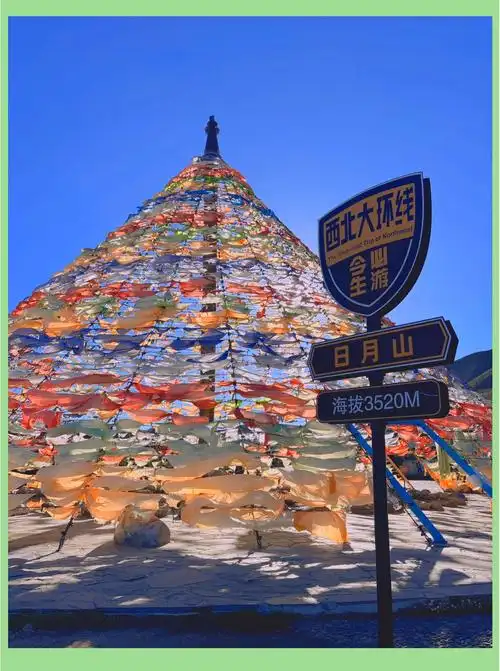 Rising to just 3,520 meters, Sun Moon Mountain punches far above its weight in geographical significance, marking not two but five major boundaries: the Loess and Tibetan Plateaus, monsoon and non-monsoon climate zones, agricultural and pastoral lands, and—crucially for hydrology—the divide between China's interior-draining and exterior-draining river basins. Standing on the pass, visitors literally gaze east into the terraced fields of Han farming culture and west across the boundless grasslands of Tibetan nomads, a contrast as stark as any in Eurasia. Geographers and road-trippers alike treat it as a kind of high-altitude crossroads of civilizations.
The mountain's fame, however, rests on a romantic legend from the 7th century. In 641 AD, Emperor Taizong of the newly unified Tang Dynasty dispatched Princess Wencheng westward to Lhasa to cement an alliance with the rising Tibetan Empire—a marriage diplomacy often compared to the contemporary Byzantine bride sent to Krum of the Bulgars or the Spanish infanta sent to Austrian Habsburgs. Tradition holds that the homesick princess, overcome by emotion at this very pass, shattered her bronze mirror into two pieces: the sun disc and the moon disc, which became emblems of the eastern and western realms. Twin pavilions now mark the supposed spot of that "mirror-breaking" moment.
A compact cultural trail threads through the site: the Princess Wencheng Temple, a nine-meter statue of the princess gazing back toward her lost homeland, the "Looking-Back Stone," and Princess Spring, where pilgrims still pause. The on-site Qinghai Ancient Road Museum and Princess Wencheng Memorial Hall house Neolithic painted pottery, bronzes, and artifacts from the tea-and-horse trade that once thundered along this corridor linking imperial China to the Roof of the World—reminiscent of the Silk Road oases further west, yet anchored firmly in Tibetan ritual and aesthetics.
Practically, the mountain makes a comfortable half-day detour. Admission runs roughly 54 yuan in peak season and 30 yuan in low season, with opening hours of 08:00 to 17:00. The pass lies about two hours' drive from Xining; public transport is virtually nonexistent, so renting a car or hiring a driver is strongly advised. All key sights cluster around the summit platform, meaning 1.5 to 2 hours suffices for a full visit, and a sightseeing shuttle is recommended in summer to conserve energy at altitude.
The best window is June through August, when the steppe glows emerald and temperatures stay mild; outside these months, winds howl across the pass and temperatures plummet, so a windproof jacket is essential even in summer, along with sunblock and basic altitude-sickness precautions. Arrive by late morning to dodge the notorious afternoon gusts, and observe local customs—do not step on mani stone piles or disturb prayer flags. Sun Moon Mountain may be small in stature, but few places on earth compress so much geography, romance, and history into a single roadside stop.
Rising to just 3,520 meters, Sun Moon Mountain punches far above its weight in geographical significance, marking not two but five major boundaries: the Loess and Tibetan Plateaus, monsoon and non-monsoon climate zones, agricultural and pastoral lands, and—crucially for hydrology—the divide between China's interior-draining and exterior-draining river basins. Standing on the pass, visitors literally gaze east into the terraced fields of Han farming culture and west across the boundless grasslands of Tibetan nomads, a contrast as stark as any in Eurasia. Geographers and road-trippers alike treat it as a kind of high-altitude crossroads of civilizations.
The mountain's fame, however, rests on a romantic legend from the 7th century. In 641 AD, Emperor Taizong of the newly unified Tang Dynasty dispatched Princess Wencheng westward to Lhasa to cement an alliance with the rising Tibetan Empire—a marriage diplomacy often compared to the contemporary Byzantine bride sent to Krum of the Bulgars or the Spanish infanta sent to Austrian Habsburgs. Tradition holds that the homesick princess, overcome by emotion at this very pass, shattered her bronze mirror into two pieces: the sun disc and the moon disc, which became emblems of the eastern and western realms. Twin pavilions now mark the supposed spot of that "mirror-breaking" moment.
A compact cultural trail threads through the site: the Princess Wencheng Temple, a nine-meter statue of the princess gazing back toward her lost homeland, the "Looking-Back Stone," and Princess Spring, where pilgrims still pause. The on-site Qinghai Ancient Road Museum and Princess Wencheng Memorial Hall house Neolithic painted pottery, bronzes, and artifacts from the tea-and-horse trade that once thundered along this corridor linking imperial China to the Roof of the World—reminiscent of the Silk Road oases further west, yet anchored firmly in Tibetan ritual and aesthetics.
Practically, the mountain makes a comfortable half-day detour. Admission runs roughly 54 yuan in peak season and 30 yuan in low season, with opening hours of 08:00 to 17:00. The pass lies about two hours' drive from Xining; public transport is virtually nonexistent, so renting a car or hiring a driver is strongly advised. All key sights cluster around the summit platform, meaning 1.5 to 2 hours suffices for a full visit, and a sightseeing shuttle is recommended in summer to conserve energy at altitude.
The best window is June through August, when the steppe glows emerald and temperatures stay mild; outside these months, winds howl across the pass and temperatures plummet, so a windproof jacket is essential even in summer, along with sunblock and basic altitude-sickness precautions. Arrive by late morning to dodge the notorious afternoon gusts, and observe local customs—do not step on mani stone piles or disturb prayer flags. Sun Moon Mountain may be small in stature, but few places on earth compress so much geography, romance, and history into a single roadside stop.