Xiangyang Museum
⭐ 4.70
Xiangcheng District, Xiangyang City, Hubei Province, China
 PARAGRAPH 1 — Historical Context
Opened in expanded form in 2024 as a nationally ranked first-class museum, Xiangyang Museum offers one of central China's most coherent chronological surveys, spanning Neolithic cultures through the late imperial era along the Hanjiang River basin. Comparable in ambition to Berlin's Neues Museum or the British Museum's chronological galleries, it anchors the broader story of Chu, a Bronze Age state roughly contemporaneous with Homeric Greece. The undisputed star is the "Bronze Leaping Horse" — standing 163 cm tall and weighing 360 kg, the largest equine bronze ever unearthed in China. Equally significant is a late Western Zhou bronze yue-axe inscribed "Min Zheng," dating to roughly the same era as Rome's founding.
PARAGRAPH 2 — Architecture
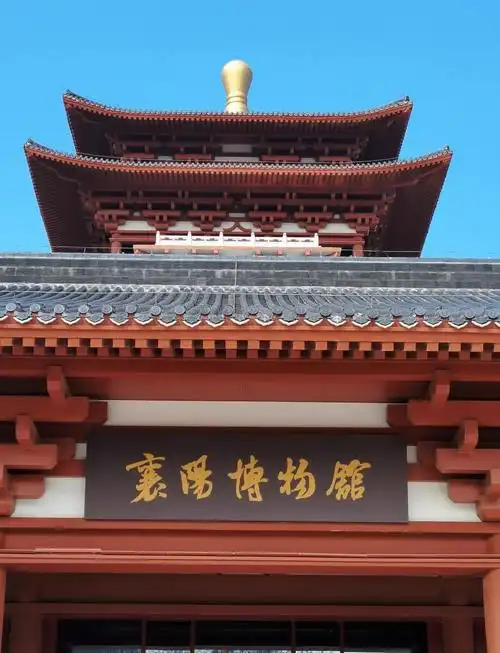
Architect He Yuru designed the complex in a monumental Tang-dynasty idiom, its layered halls cascading up the hillside in a manner reminiscent of Kyoto's hillside temple compounds or the tiered massing of Rome's Palatine Hill palaces. Crowning the ensemble stands the 52-meter Phoenix Pavilion, whose upper terraces command sweeping views over the confluence of the Hanjiang River and the ancient walled city below. Inside, six galleries unfold in strict chronological order — Prehistory, Xia-Shang-Zhou, Qin-Han, Three Kingdoms through Southern and Northern Dynasties, Sui-Tang-Song, and Yuan-Ming-Qing — translating architectural grandeur into a clear narrative spine.
PARAGRAPH 3 — Cultural Significance
Awarded one of China's "Top Ten Exhibition Designs," the museum's displays lean into immersive technology: half-painting dioramas, dynamic projections, and synchronized soundscapes reconstruct Han dynasty markets, Chu bronze foundries, and Three Kingdoms battlefields with cinematic flair — a curatorial approach rivaling Istanbul's Hagia Sophia History Museum. Visitors are greeted by endearing Eastern Han glazed pottery watchdogs and miniature ceramic towers, charming reminders of daily life that share stylistic DNA with Greco-Buddhist funerary figurines traveling the Silk Road. A first-floor interactive area lets guests try ancient pitch-pot games, making the venue a rewarding choice for families.
PARAGRAPH 4 — Practical Visit Information
The museum sits at 228 Shengli Street, Xiangcheng District, just steps from the Tang Dynasty Film City and the Xianshou Hill cultural zone. Hours are Tuesday through Sunday, 9:00 to 17:00, with last entry at 16:00; it closes Mondays except on Chinese public holidays. As of December 30, 2025, reservations have been abolished — visitors simply present a passport at the gate for complimentary entry. Electronic audio guides rent for around 20 yuan, and multilingual guided tours can be booked in advance by calling 0710-3513330.
PARAGRAPH 5 — Why Visit
For Western travelers tracing Silk Road routes or following the campaigns of Caesar's contemporary, the strategist Zhuge Liang, who famously held this very city, Xiangyang Museum offers an accessible, free, and richly contextualized portal into deep Chinese history. Plan 2.5 to 3.5 hours for a thorough visit, or roughly 1.5 hours for highlights, and visit weekday mornings for quieter galleries. Afterwards, continue to nearby Xianshou Pavilion, the Yang Gong Stele, Tang Dynasty Film City, and the Meng Haoran Cultural Garden — together forming an evocative "climb high, read history, admire scenery" circuit through one of central China's most storied landscapes.
PARAGRAPH 1 — Historical Context
Opened in expanded form in 2024 as a nationally ranked first-class museum, Xiangyang Museum offers one of central China's most coherent chronological surveys, spanning Neolithic cultures through the late imperial era along the Hanjiang River basin. Comparable in ambition to Berlin's Neues Museum or the British Museum's chronological galleries, it anchors the broader story of Chu, a Bronze Age state roughly contemporaneous with Homeric Greece. The undisputed star is the "Bronze Leaping Horse" — standing 163 cm tall and weighing 360 kg, the largest equine bronze ever unearthed in China. Equally significant is a late Western Zhou bronze yue-axe inscribed "Min Zheng," dating to roughly the same era as Rome's founding.
PARAGRAPH 2 — Architecture
Architect He Yuru designed the complex in a monumental Tang-dynasty idiom, its layered halls cascading up the hillside in a manner reminiscent of Kyoto's hillside temple compounds or the tiered massing of Rome's Palatine Hill palaces. Crowning the ensemble stands the 52-meter Phoenix Pavilion, whose upper terraces command sweeping views over the confluence of the Hanjiang River and the ancient walled city below. Inside, six galleries unfold in strict chronological order — Prehistory, Xia-Shang-Zhou, Qin-Han, Three Kingdoms through Southern and Northern Dynasties, Sui-Tang-Song, and Yuan-Ming-Qing — translating architectural grandeur into a clear narrative spine.
PARAGRAPH 3 — Cultural Significance
Awarded one of China's "Top Ten Exhibition Designs," the museum's displays lean into immersive technology: half-painting dioramas, dynamic projections, and synchronized soundscapes reconstruct Han dynasty markets, Chu bronze foundries, and Three Kingdoms battlefields with cinematic flair — a curatorial approach rivaling Istanbul's Hagia Sophia History Museum. Visitors are greeted by endearing Eastern Han glazed pottery watchdogs and miniature ceramic towers, charming reminders of daily life that share stylistic DNA with Greco-Buddhist funerary figurines traveling the Silk Road. A first-floor interactive area lets guests try ancient pitch-pot games, making the venue a rewarding choice for families.
PARAGRAPH 4 — Practical Visit Information
The museum sits at 228 Shengli Street, Xiangcheng District, just steps from the Tang Dynasty Film City and the Xianshou Hill cultural zone. Hours are Tuesday through Sunday, 9:00 to 17:00, with last entry at 16:00; it closes Mondays except on Chinese public holidays. As of December 30, 2025, reservations have been abolished — visitors simply present a passport at the gate for complimentary entry. Electronic audio guides rent for around 20 yuan, and multilingual guided tours can be booked in advance by calling 0710-3513330.
PARAGRAPH 5 — Why Visit
For Western travelers tracing Silk Road routes or following the campaigns of Caesar's contemporary, the strategist Zhuge Liang, who famously held this very city, Xiangyang Museum offers an accessible, free, and richly contextualized portal into deep Chinese history. Plan 2.5 to 3.5 hours for a thorough visit, or roughly 1.5 hours for highlights, and visit weekday mornings for quieter galleries. Afterwards, continue to nearby Xianshou Pavilion, the Yang Gong Stele, Tang Dynasty Film City, and the Meng Haoran Cultural Garden — together forming an evocative "climb high, read history, admire scenery" circuit through one of central China's most storied landscapes.