Tang City Film and Television Base
⭐ 3.50
Tang City Film and Television Base, Xiangcheng District, Xiangyang City, Hubei Province, China
 Between 618 and 907 AD, the Tang Dynasty presided over a golden age of Chinese civilization, its capital Chang'an home to roughly one million residents—making it larger than any contemporary city from Constantinople to Baghdad. While medieval Europe navigated the early Middle Ages, Chang'an's grid-pattern streets buzzed with Sogdian merchants, Persian monks, and Japanese students, anticipating the cosmopolitan Silk Road network. Tang City Film and TV Base recreates this lost metropolis in walkable form, its layout following the original ward-based city plan that later inspired Japan's Kyoto and Nara. It offers visitors a rare, tangible vision of a civilization that shaped East Asia for centuries.
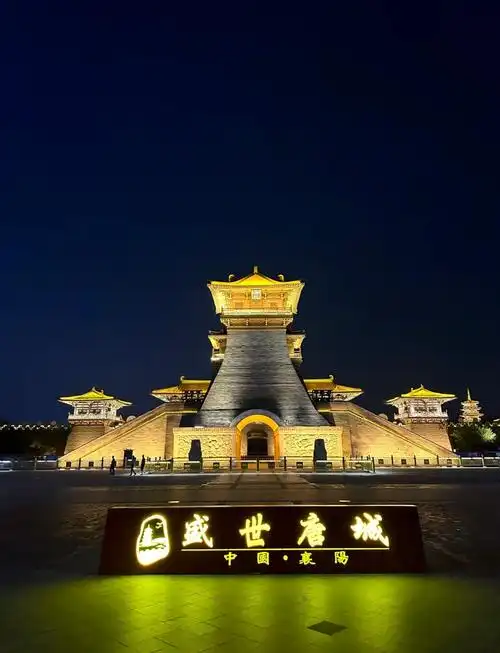
The complex centers on two monumental gate towers—Zhuque Gate and Mingde Gate—modeled after the original southern entrances to Chang'an, each rising several stories with sweeping tiled roofs and vermillion columns. Beyond them stretches Zhuque Boulevard, flanked by reconstructions of the East and West Markets, where Tang-era shopfronts recreate the commercial heart of imperial China. Qinglong Temple stands as a serene Buddhist sanctuary, while landmarks like Hu Yu Tower, the Rainbow Bridge, and the palatial Hua'e Xianghui Tower showcase the court's opulent wooden architecture. Compared to Japanese temple complexes at Nara or Kyoto's imperial estates, the scale here feels distinctly Chinese—broader, more theatrical, and unapologetically grand.
Since its construction, Tang City has served as the cinematic stand-in for ancient Chang'an in major productions. Director Chen Kaige originally built the entire complex for his 2017 film "Legend of the Demon Cat," a visually lavish supernatural thriller. More recently, hit series "A Dream of Splendor," "Joy of Life 2," and "The Lychees of Chang'an" used the same streets and towers as backdrops, drawing devoted fans eager to photograph their favorite scenes. For travelers unfamiliar with these titles, the appeal lies simply in stepping into a living film set where every corner reveals a new tableau of imperial China.
The base sits in Xiangcheng District, Xiangyang, accessible by buses 66, 305, 505, 534, and 546, with parking available for around 30 yuan per day. Daytime admission runs about 90 yuan, while night tickets cost 100 to 125 yuan; the park typically closes on Mondays for maintenance. Plan to arrive around 4 pm to catch golden-hour light on the gate towers before transitioning into the evening light show. Allocate three to four hours for a comfortable visit. Rent hanfu (traditional dress) outside the park for better rates, and bring water and snacks—on-site dining is pricey. Comfortable walking shoes are essential given the vast distances.
The real magic unfolds after dark, when "Dream of Great Tang," a procession-style live performance, transforms the streets into a moving stage. Spectators follow costumed performers past illuminated palaces, choreographed Tang dances, poetry recitations, and dramatic water-screen projections that paint the walls with shifting imagery. The combination of glowing architecture, traditional music, and theatrical staging rivals the nighttime spectaculars at major theme parks worldwide, though rooted firmly in historical authenticity. For photographers, the interplay of silhouettes against golden lanterns offers some of China's most striking night imagery—capturing the fantasy of imperial China that has captivated travelers along the Silk Road for centuries.
Between 618 and 907 AD, the Tang Dynasty presided over a golden age of Chinese civilization, its capital Chang'an home to roughly one million residents—making it larger than any contemporary city from Constantinople to Baghdad. While medieval Europe navigated the early Middle Ages, Chang'an's grid-pattern streets buzzed with Sogdian merchants, Persian monks, and Japanese students, anticipating the cosmopolitan Silk Road network. Tang City Film and TV Base recreates this lost metropolis in walkable form, its layout following the original ward-based city plan that later inspired Japan's Kyoto and Nara. It offers visitors a rare, tangible vision of a civilization that shaped East Asia for centuries.
The complex centers on two monumental gate towers—Zhuque Gate and Mingde Gate—modeled after the original southern entrances to Chang'an, each rising several stories with sweeping tiled roofs and vermillion columns. Beyond them stretches Zhuque Boulevard, flanked by reconstructions of the East and West Markets, where Tang-era shopfronts recreate the commercial heart of imperial China. Qinglong Temple stands as a serene Buddhist sanctuary, while landmarks like Hu Yu Tower, the Rainbow Bridge, and the palatial Hua'e Xianghui Tower showcase the court's opulent wooden architecture. Compared to Japanese temple complexes at Nara or Kyoto's imperial estates, the scale here feels distinctly Chinese—broader, more theatrical, and unapologetically grand.
Since its construction, Tang City has served as the cinematic stand-in for ancient Chang'an in major productions. Director Chen Kaige originally built the entire complex for his 2017 film "Legend of the Demon Cat," a visually lavish supernatural thriller. More recently, hit series "A Dream of Splendor," "Joy of Life 2," and "The Lychees of Chang'an" used the same streets and towers as backdrops, drawing devoted fans eager to photograph their favorite scenes. For travelers unfamiliar with these titles, the appeal lies simply in stepping into a living film set where every corner reveals a new tableau of imperial China.
The base sits in Xiangcheng District, Xiangyang, accessible by buses 66, 305, 505, 534, and 546, with parking available for around 30 yuan per day. Daytime admission runs about 90 yuan, while night tickets cost 100 to 125 yuan; the park typically closes on Mondays for maintenance. Plan to arrive around 4 pm to catch golden-hour light on the gate towers before transitioning into the evening light show. Allocate three to four hours for a comfortable visit. Rent hanfu (traditional dress) outside the park for better rates, and bring water and snacks—on-site dining is pricey. Comfortable walking shoes are essential given the vast distances.
The real magic unfolds after dark, when "Dream of Great Tang," a procession-style live performance, transforms the streets into a moving stage. Spectators follow costumed performers past illuminated palaces, choreographed Tang dances, poetry recitations, and dramatic water-screen projections that paint the walls with shifting imagery. The combination of glowing architecture, traditional music, and theatrical staging rivals the nighttime spectaculars at major theme parks worldwide, though rooted firmly in historical authenticity. For photographers, the interplay of silhouettes against golden lanterns offers some of China's most striking night imagery—capturing the fantasy of imperial China that has captivated travelers along the Silk Road for centuries.