Xiangyang Ancient City Wall
⭐ 4.60
No. 128, North Street, Xiangcheng District, Xiangyang, Hubei, China
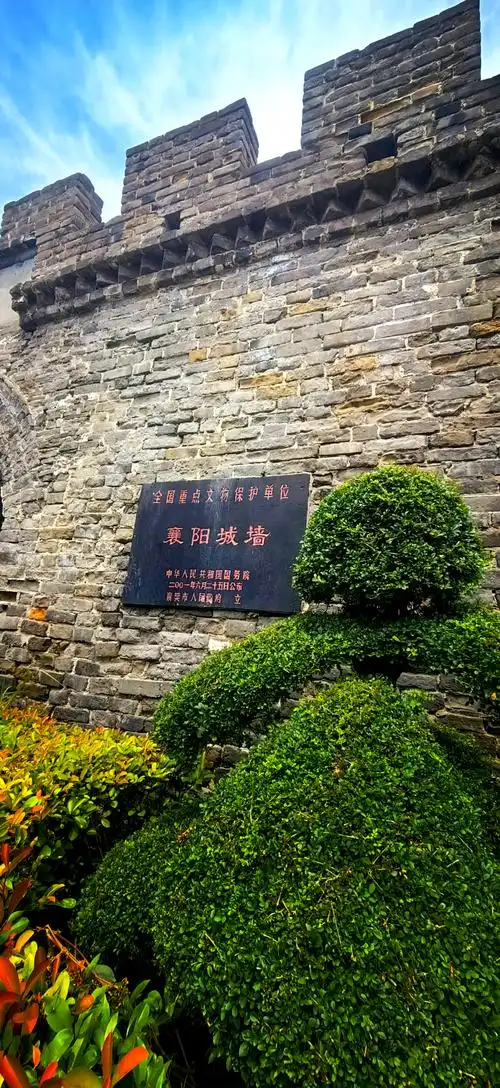 Xiangyang's city wall traces its origins to the Han Dynasty over two thousand years ago, though the imposing structure standing today largely follows Ming-era specifications (roughly contemporary with the Tudor period in England). Reinforced through the Tang, Song, and Qing dynasties, the fortress became famous in military lore—legendary general Yue Fei resisted Jin invaders here in the 12th century, and romantic tales of Guo Jing and Huang Rong defending the city inspired generations of Chinese readers. Designated a nationally protected heritage site in 2001, the wall stands as a remarkable testament to China's enduring martial traditions.
For sheer scale, the fortifications dwarf many Western counterparts. The perimeter measures 7,331 meters, with walls averaging ten meters in height and a staggering fourteen-meter thickness at the base—roughly comparable to Constantinople's Theodosian Walls but built centuries later. Six main gates, each protected by a U-shaped barbican, plus corner towers, defensive platforms, and over four thousand crenellations formed a sophisticated defensive network. Outside, the moat averages 180 meters wide and stretches up to 250 meters at its broadest, often cited as Asia's widest artificial waterway and still serving flood-control purposes today.
The wall links together several layered historical sites worth pausing at. Lady's City (Furen Cheng) commemorates a Han-era general's wife who reportedly rallied townspeople to build fortifications against invaders. Nearby, Zhaoming Terrace honors the Liang Dynasty crown prince who compiled China's celebrated Wenxuan literary anthology here. Walking the ramparts, travelers can run their fingers along centuries-old bricks while gazing down at the gray-tiled rooftops and lively street life of the restored Beijie quarter below.
Entry to the wall itself is free and open round-the-clock, a rare gift for budget travelers. The most rewarding route begins at the Linhan Gate—where Yang Siqi, the Qing-dynasty general, famously saw off his daughter into battle—and follows the northern ramparts roughly two kilometers westward to Lady's City. Note that the eastern and southern sections are fragmented by modern construction, so visitors must retrace their steps rather than completing a full circuit. The adjacent Xiangyang Prince's Mansion exhibition halls open daily from 8:30 a.m. to 5:30 p.m.
Timing matters for the full experience. From 5:00 to 7:30 p.m., the setting sun gilds the Han River's broad waters while the moat and walls light up in soft golden hues—an atmosphere reminiscent of summer evenings along the River Thames past the Tower of London. Early risers will find the ramparts blissfully empty between 7:00 and 8:30 a.m., ideal for unobstructed photography. Tucked nearby in the Beijie and Guanjiang alleyways, family-run noodle shops serve steaming bowls of Xiangyang beef noodles alongside sweet brown-sugar cakes and local yellow wine, all at refreshingly modest prices.
Xiangyang's city wall traces its origins to the Han Dynasty over two thousand years ago, though the imposing structure standing today largely follows Ming-era specifications (roughly contemporary with the Tudor period in England). Reinforced through the Tang, Song, and Qing dynasties, the fortress became famous in military lore—legendary general Yue Fei resisted Jin invaders here in the 12th century, and romantic tales of Guo Jing and Huang Rong defending the city inspired generations of Chinese readers. Designated a nationally protected heritage site in 2001, the wall stands as a remarkable testament to China's enduring martial traditions.
For sheer scale, the fortifications dwarf many Western counterparts. The perimeter measures 7,331 meters, with walls averaging ten meters in height and a staggering fourteen-meter thickness at the base—roughly comparable to Constantinople's Theodosian Walls but built centuries later. Six main gates, each protected by a U-shaped barbican, plus corner towers, defensive platforms, and over four thousand crenellations formed a sophisticated defensive network. Outside, the moat averages 180 meters wide and stretches up to 250 meters at its broadest, often cited as Asia's widest artificial waterway and still serving flood-control purposes today.
The wall links together several layered historical sites worth pausing at. Lady's City (Furen Cheng) commemorates a Han-era general's wife who reportedly rallied townspeople to build fortifications against invaders. Nearby, Zhaoming Terrace honors the Liang Dynasty crown prince who compiled China's celebrated Wenxuan literary anthology here. Walking the ramparts, travelers can run their fingers along centuries-old bricks while gazing down at the gray-tiled rooftops and lively street life of the restored Beijie quarter below.
Entry to the wall itself is free and open round-the-clock, a rare gift for budget travelers. The most rewarding route begins at the Linhan Gate—where Yang Siqi, the Qing-dynasty general, famously saw off his daughter into battle—and follows the northern ramparts roughly two kilometers westward to Lady's City. Note that the eastern and southern sections are fragmented by modern construction, so visitors must retrace their steps rather than completing a full circuit. The adjacent Xiangyang Prince's Mansion exhibition halls open daily from 8:30 a.m. to 5:30 p.m.
Timing matters for the full experience. From 5:00 to 7:30 p.m., the setting sun gilds the Han River's broad waters while the moat and walls light up in soft golden hues—an atmosphere reminiscent of summer evenings along the River Thames past the Tower of London. Early risers will find the ramparts blissfully empty between 7:00 and 8:30 a.m., ideal for unobstructed photography. Tucked nearby in the Beijie and Guanjiang alleyways, family-run noodle shops serve steaming bowls of Xiangyang beef noodles alongside sweet brown-sugar cakes and local yellow wine, all at refreshingly modest prices.