Nanyue Martyrs' Shrine
⭐ 4.20
No. 1, Zhonglieci Road, Nanyue Town, Nanyue District, Hengyang City, Hunan Province, China
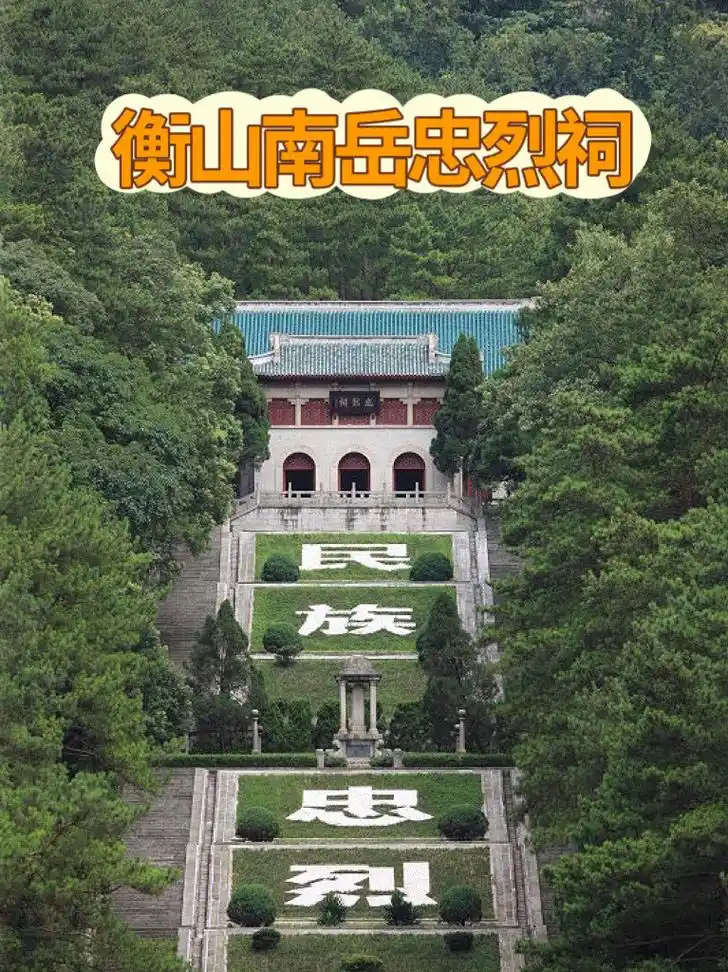 Built between 1938 and 1943, the shrine arose during China's darkest hours, when the wartime government had retreated deep into the mountainous interior. Its completion on July 7, 1943—the sixth anniversary of the Marco Polo Bridge Incident—marked a defiant act of remembrance. Comparable in gravity to the Normandy American Cemetery or Belgium's Menin Gate, the site honors a front often glossed over in Western WWII narratives: a conflict that claimed up to 20 million Chinese lives and immobilized half a million Japanese troops, profoundly shaping the Pacific War's outcome.
The architectural ensemble deliberately echoes Sun Yat-sen's mausoleum on Nanjing's Purple Mountain, employing the same stately axial progression familiar to visitors of European neoclassical monuments such as Paris's Les Invalides or Melbourne's Shrine of Remembrance. Five successive courts ascend the slope: a triple-arched gateway, the towering July 7th Memorial Tower crowned by five stone cannonballs representing the five ethnic groups united against invasion, the Memorial Hall, the Anting Campaign Pavilion, and finally the Sacrificial Hall bearing Chiang Kai-shek's calligraphic plaque—where the character for "martyrdom" deliberately omits a stroke to symbolize victory arriving "one stroke sooner."
Surrounding the central axis lie 19 tombs: 12 individual graves holding generals such as Zheng Zuomin and Sun Mingjin, plus seven collective burial mounds where tens of thousands of unidentified soldiers rest. The Anting Campaign Pavilion features a blank stele acknowledging that words cannot encompass such sacrifice; nearby stands a simple stone requesting "Visitors here, doff your hats in salute." Inside the Sacrificial Hall, the central spirit tablet honors all war dead, flanked by biographical inscriptions of 37 generals and 36 panels of patriotic verse—part memorial, part open-air calligraphy museum blending grief with artistic heritage.
The shrine is free to enter but requires a Mount Heng scenic-area ticket. Hours typically run Tuesday through Sunday, 8:00–17:30 in peak season (April–November) and 8:30–17:00 in winter; Mondays are reserved for maintenance. From Nanyue Old Town, an eco-bus reaches the Zhonglieci stop in roughly ten minutes—a far easier alternative to the steep one-hour uphill walk. Plan 90 minutes to two hours for a contemplative circuit, dress modestly, maintain solemn silence, and remove hats at the salute stone. August brings Hengshan heat and sudden showers, so sun protection, rain gear, and sturdy footwear are essential. Combine with the nearby Grand Temple of Mount Heng for a full day.
For Western travelers, the shrine offers rare insight into a war that reshaped the world yet remains a footnote in most European and American curricula. Few memorials so openly bridge political divides—generals of the Nationalist army rest alongside Communist fallen—presenting the conflict as a unified national struggle rather than an internal affair. Set against the mist-clad slopes of one of China's five sacred peaks, the site fuses imperial landscape aesthetics with republican-era monumentalism, much as the Commonwealth War Graves Commission weaves pastoral English settings with universal symbolism of loss and remembrance.
Built between 1938 and 1943, the shrine arose during China's darkest hours, when the wartime government had retreated deep into the mountainous interior. Its completion on July 7, 1943—the sixth anniversary of the Marco Polo Bridge Incident—marked a defiant act of remembrance. Comparable in gravity to the Normandy American Cemetery or Belgium's Menin Gate, the site honors a front often glossed over in Western WWII narratives: a conflict that claimed up to 20 million Chinese lives and immobilized half a million Japanese troops, profoundly shaping the Pacific War's outcome.
The architectural ensemble deliberately echoes Sun Yat-sen's mausoleum on Nanjing's Purple Mountain, employing the same stately axial progression familiar to visitors of European neoclassical monuments such as Paris's Les Invalides or Melbourne's Shrine of Remembrance. Five successive courts ascend the slope: a triple-arched gateway, the towering July 7th Memorial Tower crowned by five stone cannonballs representing the five ethnic groups united against invasion, the Memorial Hall, the Anting Campaign Pavilion, and finally the Sacrificial Hall bearing Chiang Kai-shek's calligraphic plaque—where the character for "martyrdom" deliberately omits a stroke to symbolize victory arriving "one stroke sooner."
Surrounding the central axis lie 19 tombs: 12 individual graves holding generals such as Zheng Zuomin and Sun Mingjin, plus seven collective burial mounds where tens of thousands of unidentified soldiers rest. The Anting Campaign Pavilion features a blank stele acknowledging that words cannot encompass such sacrifice; nearby stands a simple stone requesting "Visitors here, doff your hats in salute." Inside the Sacrificial Hall, the central spirit tablet honors all war dead, flanked by biographical inscriptions of 37 generals and 36 panels of patriotic verse—part memorial, part open-air calligraphy museum blending grief with artistic heritage.
The shrine is free to enter but requires a Mount Heng scenic-area ticket. Hours typically run Tuesday through Sunday, 8:00–17:30 in peak season (April–November) and 8:30–17:00 in winter; Mondays are reserved for maintenance. From Nanyue Old Town, an eco-bus reaches the Zhonglieci stop in roughly ten minutes—a far easier alternative to the steep one-hour uphill walk. Plan 90 minutes to two hours for a contemplative circuit, dress modestly, maintain solemn silence, and remove hats at the salute stone. August brings Hengshan heat and sudden showers, so sun protection, rain gear, and sturdy footwear are essential. Combine with the nearby Grand Temple of Mount Heng for a full day.
For Western travelers, the shrine offers rare insight into a war that reshaped the world yet remains a footnote in most European and American curricula. Few memorials so openly bridge political divides—generals of the Nationalist army rest alongside Communist fallen—presenting the conflict as a unified national struggle rather than an internal affair. Set against the mist-clad slopes of one of China's five sacred peaks, the site fuses imperial landscape aesthetics with republican-era monumentalism, much as the Commonwealth War Graves Commission weaves pastoral English settings with universal symbolism of loss and remembrance.