Zhahe Cultural Park
⭐ 3.20
Zhahe Cultural Park, Bengshan District, Bengbu City, Anhui Province, China
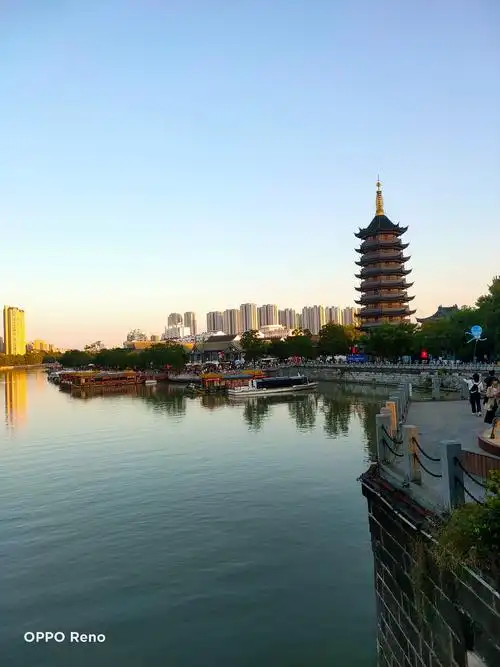 The Huai River basin has long been one of China's most flood-prone regions, and the devastating 1950 floods, which displaced millions and reshaped the country's political agenda, prompted the new People's Republic to launch an unprecedented hydraulic campaign. The Bengbu Sluice, begun in the early 1950s, was a flagship of this initiative, comparable in ambition to America's TVA dams or the Netherlands' Delta Works, though on a more modest scale. Mao Zedong personally inscribed the rallying cry "We must certainly tame the Huai River," and a memorial stone preserves that call to action. Designated a National Water Conservancy Scenic Area in 2004 and graded 4A from 2011 to 2016, the site now serves as living testimony to mid-twentieth-century Chinese nation-building.
The architectural centerpiece is the 28-bay sluice gate stretching across the river, a concrete leviathan whose rhythmic piers resemble a vast Roman aqueduct reimagined for flood control. Alongside it stand a modern ship lock, a hydropower station, and a graceful double-arch diversion bridge, together creating a striking ensemble of utilitarian beauty. A sightseeing elevator hoists visitors to an elevated observation deck for sweeping views over the Huai and its working machinery, while the diversion levee platform is the prime vantage point for photographing the entire complex in one frame, the kind of shot reminiscent of classic European industrial panoramas.
Beyond its engineering pedigree, the park is a poignant cultural touchstone. Premier Wen Jiabao's inspection tour left its own historical imprint along the diversion levee, and the site is increasingly woven into regional cultural planning, linked with the proposed Huai River National Cultural Park, the legendary Yu the Great flood-control mythology, and the Neolithic artifacts of the Shuangdun site. For travelers seeking to understand how a young revolutionary state harnessed its rivers to feed and protect its people, this location distills that narrative into a single, walkable landscape.
Getting here is straightforward: the park sits at No. 1 Heihu Mountain Road in Bengbu's Yuhui District, roughly 6 kilometers from downtown. Buses 301 and 311 run directly to the entrance, or simply set your GPS to "Bengbu Sluice Water Conservancy Scenic Area." Entry is free and parking is ample, though weekends fill up. Note that signage is almost entirely in Chinese and there is no English interpretation at key viewpoints, so a translation app is highly recommended. Drone operators must apply for permits in advance; spontaneous flights are prohibited.
Allow two to three hours for a comfortable visit, following the classic loop: main entrance, the 28-bay gate observation platform, the diversion levee viewpoint, the thousand-acre wetland park, and finally the west bank for sunset over the Huai. In summer, arrive before 9 a.m. or after 4 p.m. to dodge the heat, and pack repellent plus long sleeves because wetland mosquitoes are aggressive. Lotus blooms peak in midsummer, while autumn draws flocks of migratory waterbirds, making it a favorite season for birders and photographers. The park pairs naturally with the Bengbu Museum and nearby Longzi Lake for a rewarding two-day itinerary in this under-visited corner of Anhui.
The Huai River basin has long been one of China's most flood-prone regions, and the devastating 1950 floods, which displaced millions and reshaped the country's political agenda, prompted the new People's Republic to launch an unprecedented hydraulic campaign. The Bengbu Sluice, begun in the early 1950s, was a flagship of this initiative, comparable in ambition to America's TVA dams or the Netherlands' Delta Works, though on a more modest scale. Mao Zedong personally inscribed the rallying cry "We must certainly tame the Huai River," and a memorial stone preserves that call to action. Designated a National Water Conservancy Scenic Area in 2004 and graded 4A from 2011 to 2016, the site now serves as living testimony to mid-twentieth-century Chinese nation-building.
The architectural centerpiece is the 28-bay sluice gate stretching across the river, a concrete leviathan whose rhythmic piers resemble a vast Roman aqueduct reimagined for flood control. Alongside it stand a modern ship lock, a hydropower station, and a graceful double-arch diversion bridge, together creating a striking ensemble of utilitarian beauty. A sightseeing elevator hoists visitors to an elevated observation deck for sweeping views over the Huai and its working machinery, while the diversion levee platform is the prime vantage point for photographing the entire complex in one frame, the kind of shot reminiscent of classic European industrial panoramas.
Beyond its engineering pedigree, the park is a poignant cultural touchstone. Premier Wen Jiabao's inspection tour left its own historical imprint along the diversion levee, and the site is increasingly woven into regional cultural planning, linked with the proposed Huai River National Cultural Park, the legendary Yu the Great flood-control mythology, and the Neolithic artifacts of the Shuangdun site. For travelers seeking to understand how a young revolutionary state harnessed its rivers to feed and protect its people, this location distills that narrative into a single, walkable landscape.
Getting here is straightforward: the park sits at No. 1 Heihu Mountain Road in Bengbu's Yuhui District, roughly 6 kilometers from downtown. Buses 301 and 311 run directly to the entrance, or simply set your GPS to "Bengbu Sluice Water Conservancy Scenic Area." Entry is free and parking is ample, though weekends fill up. Note that signage is almost entirely in Chinese and there is no English interpretation at key viewpoints, so a translation app is highly recommended. Drone operators must apply for permits in advance; spontaneous flights are prohibited.
Allow two to three hours for a comfortable visit, following the classic loop: main entrance, the 28-bay gate observation platform, the diversion levee viewpoint, the thousand-acre wetland park, and finally the west bank for sunset over the Huai. In summer, arrive before 9 a.m. or after 4 p.m. to dodge the heat, and pack repellent plus long sleeves because wetland mosquitoes are aggressive. Lotus blooms peak in midsummer, while autumn draws flocks of migratory waterbirds, making it a favorite season for birders and photographers. The park pairs naturally with the Bengbu Museum and nearby Longzi Lake for a rewarding two-day itinerary in this under-visited corner of Anhui.