Misty Rain Corridor
⭐ 4.50
Tushan Scenic Area, Yuhui District, Bengbu City, Anhui Province, China
 Built gradually during the Ming and Qing dynasties (roughly 1368–1911), the corridor grew organically over centuries as local merchants and residents extended their own private covered walkways along the canal until these merged into one continuous structure. This bottom-up evolution mirrors the organic growth of medieval European market towns, where guild houses and arcaded streets likewise accreted over generations. Though its original purpose was purely practical—to shelter travelers, traders, and boatmen from sun and rain—it evolved into one of China's most beloved public spaces, embodying the Jiangnan ethos of "commerce and dwelling united, people and water interdependent."
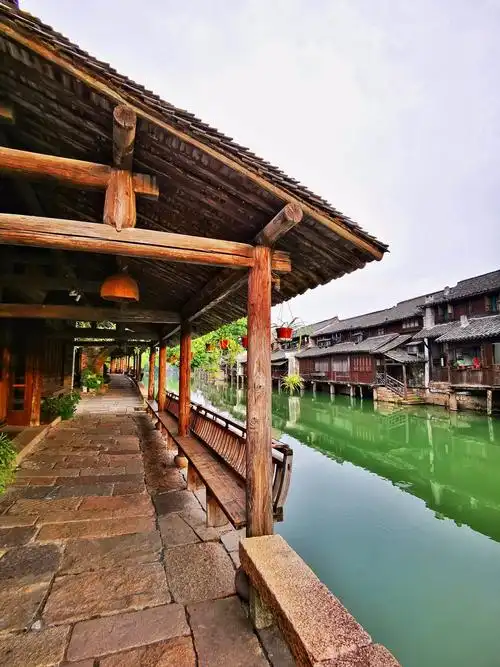
The structure is a masterclass in traditional Chinese timber architecture. Rows of round wooden columns support an unbroken tiled roof with gently upturned eaves, while the corridor itself measures two to three meters wide and is furnished with wooden "beauty reclining" benches (meirenkào) and stone seats. One side faces the canal, the other the old street, creating a transparent threshold where light filters between columns. Carved lattice windows and decorative elements punctuate the walls, and the restrained palette of weathered wood and grey tile reflects the Jiangnan craftsman's principle of using local materials to harmonize with the landscape—a sensibility akin to the vernacular building traditions of Tuscany or the Cotswolds.
What sets Xitang apart from heavily commercialized water towns is that it remains genuinely inhabited. Along the corridor, locals still dry laundry, tend potted flowers, and chat on their doorsteps—scenes largely unchanged for generations. The walkway links several historic sites, including Xiyuan Garden, Zuiyuan, the Temple of the Grain-King Protector, and ancient bridges like Songzi Laifeng and Yongning. In misty weather, the canal outside dissolves into soft veils of vapor where boats glide past, giving the corridor its evocative name and recreating the exact atmosphere celebrated in classical Chinese landscape painting.
Admission to the corridor itself is included in the Xitang Ancient Town entrance ticket, which costs around 95 RMB per person. Visitors can enter free of charge before 8:00 AM or after 5:00 PM (extended to 9:00 PM on public holidays), paying only for smaller individual attractions inside. The town is most easily reached by high-speed rail to Jiashan South Station, followed by a short bus or taxi ride; from Shanghai or Hangzhou by car the journey takes roughly 1 to 1.5 hours, and direct public buses from both cities also run regularly.
The optimal visiting windows are early morning (6:00–8:00 AM) and late afternoon, when soft light and thinner crowds reveal the corridor at its most atmospheric—rain or mist transforms it into the very scene its name promises. Plan to linger: settle onto a meirenkào bench, listen to rain on the tiles, and watch boats pass. By night, illuminated reflections shimmer on the water, and a ride on a traditional rowboat through the narrow canals offers another perspective. Wear flat, non-slip shoes for the wet flagstones, mind children near unguarded water sections, and respect residents going quietly about their daily lives.
Built gradually during the Ming and Qing dynasties (roughly 1368–1911), the corridor grew organically over centuries as local merchants and residents extended their own private covered walkways along the canal until these merged into one continuous structure. This bottom-up evolution mirrors the organic growth of medieval European market towns, where guild houses and arcaded streets likewise accreted over generations. Though its original purpose was purely practical—to shelter travelers, traders, and boatmen from sun and rain—it evolved into one of China's most beloved public spaces, embodying the Jiangnan ethos of "commerce and dwelling united, people and water interdependent."
The structure is a masterclass in traditional Chinese timber architecture. Rows of round wooden columns support an unbroken tiled roof with gently upturned eaves, while the corridor itself measures two to three meters wide and is furnished with wooden "beauty reclining" benches (meirenkào) and stone seats. One side faces the canal, the other the old street, creating a transparent threshold where light filters between columns. Carved lattice windows and decorative elements punctuate the walls, and the restrained palette of weathered wood and grey tile reflects the Jiangnan craftsman's principle of using local materials to harmonize with the landscape—a sensibility akin to the vernacular building traditions of Tuscany or the Cotswolds.
What sets Xitang apart from heavily commercialized water towns is that it remains genuinely inhabited. Along the corridor, locals still dry laundry, tend potted flowers, and chat on their doorsteps—scenes largely unchanged for generations. The walkway links several historic sites, including Xiyuan Garden, Zuiyuan, the Temple of the Grain-King Protector, and ancient bridges like Songzi Laifeng and Yongning. In misty weather, the canal outside dissolves into soft veils of vapor where boats glide past, giving the corridor its evocative name and recreating the exact atmosphere celebrated in classical Chinese landscape painting.
Admission to the corridor itself is included in the Xitang Ancient Town entrance ticket, which costs around 95 RMB per person. Visitors can enter free of charge before 8:00 AM or after 5:00 PM (extended to 9:00 PM on public holidays), paying only for smaller individual attractions inside. The town is most easily reached by high-speed rail to Jiashan South Station, followed by a short bus or taxi ride; from Shanghai or Hangzhou by car the journey takes roughly 1 to 1.5 hours, and direct public buses from both cities also run regularly.
The optimal visiting windows are early morning (6:00–8:00 AM) and late afternoon, when soft light and thinner crowds reveal the corridor at its most atmospheric—rain or mist transforms it into the very scene its name promises. Plan to linger: settle onto a meirenkào bench, listen to rain on the tiles, and watch boats pass. By night, illuminated reflections shimmer on the water, and a ride on a traditional rowboat through the narrow canals offers another perspective. Wear flat, non-slip shoes for the wet flagstones, mind children near unguarded water sections, and respect residents going quietly about their daily lives.