Bengbu Grand Theatre
⭐ 3.50
Northwest side of the intersection of Donghai Avenue and Shengli Road, Bengshan District, Bengbu City, Anhui Province, China
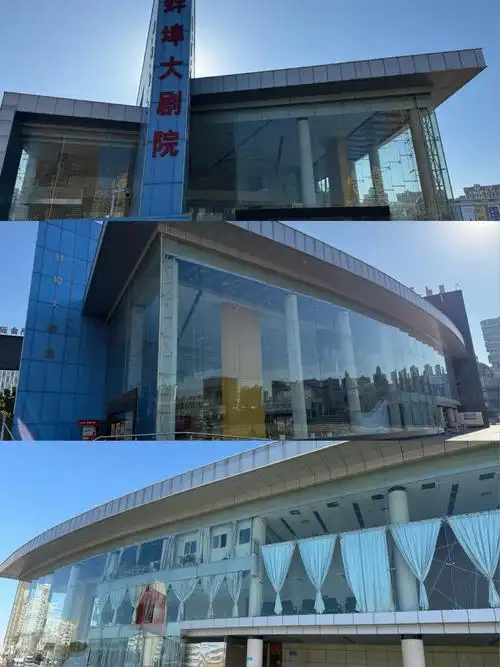 Bengbu, a strategic railway junction where the Beijing-Shanghai and Longhai lines intersect, has long been a gateway between northern and southern China. The city's cultural ambitions crystallized in 2004 with the opening of the Grand Theatre, anchoring the Huai River Cultural Plaza alongside the public library and convention centre. PTW Architects, an Australian firm internationally recognized for aquatic and stadium design, lent the structure a cosmopolitan sensibility unusual for a mid-tier Chinese city, suggesting a quiet dialogue with Sydney's own harbour-side performing arts tradition.
The building's signature gesture, a curvaceous roof mimicking a raised piano lid and a façade evoking ivory keys, transforms a 9,373-square-metre concrete volume into pure lyricism. By day, the metallic curves catch the Anhui sun; by night, carefully calibrated LED lighting traces the instrument's contours, making it arguably the most photogenic cultural building in the province. Architecture enthusiasts will recognize echoes of Frank Gehry's flowing metallic forms, though rendered in a more restrained, classical idiom.
Inside, the 950-seat hall divides into 712 orchestra and 238 balcony seats, with a flexible升降 stage (mechanized stage and orchestra pit lifts) engineered to international standards. The venue has welcomed the Russian National Symphony, full-length productions of Swan Lake, and award-winning Chinese dance dramas like Da Yu, bringing world-class performance to a region historically underserved by major touring companies. State-owned management balances artistic公益 with commercial sustainability, keeping ticket prices accessible.
Practical visiting requires planning: the auditorium is generally inaccessible without a performance ticket, so consult "Bengbu Wenluti" on WeChat or Damai.com for current programmes. The plaza itself rewards a half-day cultural walk, beginning at Han Meilin's whimsical sculpture marking China's geographical north-south dividing line, continuing to nearby Longzi Lake for landscaped strolls, and optionally extending to the Bengbu Museum (advance reservation required) for insights into the city's railway heritage.
Getting there is straightforward: bus 109 stops directly at the venue, while taxis remain inexpensive by Western standards. On-site parking charges just 5 yuan for up to three hours, capped at 15 yuan daily, with two hours free for electric vehicles. Dress smartly, arrive 30 minutes early, and silence your phone, standard etiquette shared with European opera houses. Pair the experience with local street food such as shao bing stuffed with fried pork fillet, a Bengbu signature, for an authentically mid-Anhui cultural afternoon.
Bengbu, a strategic railway junction where the Beijing-Shanghai and Longhai lines intersect, has long been a gateway between northern and southern China. The city's cultural ambitions crystallized in 2004 with the opening of the Grand Theatre, anchoring the Huai River Cultural Plaza alongside the public library and convention centre. PTW Architects, an Australian firm internationally recognized for aquatic and stadium design, lent the structure a cosmopolitan sensibility unusual for a mid-tier Chinese city, suggesting a quiet dialogue with Sydney's own harbour-side performing arts tradition.
The building's signature gesture, a curvaceous roof mimicking a raised piano lid and a façade evoking ivory keys, transforms a 9,373-square-metre concrete volume into pure lyricism. By day, the metallic curves catch the Anhui sun; by night, carefully calibrated LED lighting traces the instrument's contours, making it arguably the most photogenic cultural building in the province. Architecture enthusiasts will recognize echoes of Frank Gehry's flowing metallic forms, though rendered in a more restrained, classical idiom.
Inside, the 950-seat hall divides into 712 orchestra and 238 balcony seats, with a flexible升降 stage (mechanized stage and orchestra pit lifts) engineered to international standards. The venue has welcomed the Russian National Symphony, full-length productions of Swan Lake, and award-winning Chinese dance dramas like Da Yu, bringing world-class performance to a region historically underserved by major touring companies. State-owned management balances artistic公益 with commercial sustainability, keeping ticket prices accessible.
Practical visiting requires planning: the auditorium is generally inaccessible without a performance ticket, so consult "Bengbu Wenluti" on WeChat or Damai.com for current programmes. The plaza itself rewards a half-day cultural walk, beginning at Han Meilin's whimsical sculpture marking China's geographical north-south dividing line, continuing to nearby Longzi Lake for landscaped strolls, and optionally extending to the Bengbu Museum (advance reservation required) for insights into the city's railway heritage.
Getting there is straightforward: bus 109 stops directly at the venue, while taxis remain inexpensive by Western standards. On-site parking charges just 5 yuan for up to three hours, capped at 15 yuan daily, with two hours free for electric vehicles. Dress smartly, arrive 30 minutes early, and silence your phone, standard etiquette shared with European opera houses. Pair the experience with local street food such as shao bing stuffed with fried pork fillet, a Bengbu signature, for an authentically mid-Anhui cultural afternoon.