Zhongshan Street
⭐ 3.20
Zhongshan Street, Longzi Lake District, Bengbu City, Anhui Province, China
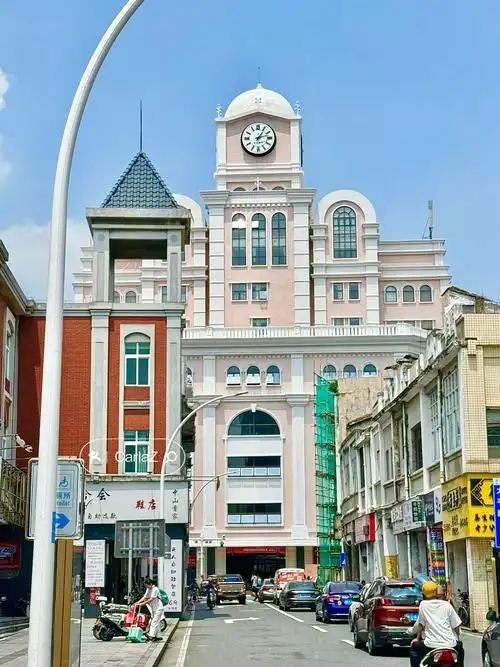 Bengbu Zhongshan Street was named in 1913, the year after the Republic of China was founded, taking its name from Sun Yat-sen, often called the George Washington of modern China. The street rose to prominence following the 1912 completion of the Tianjin-Pukou Railway, a thousand-kilometer line that was Asia's most ambitious rail project at the time and parallels the transformative impact of America's Transcontinental Railroad. Just as Chicago and Sacramento boomed with rail access, Bengbu transformed overnight from a sleepy market town into a thriving commercial hub. By the 1920s, Zhongshan Street had earned the nickname "Wall Street of Northern Anhui," anchoring trade in grain, salt, and textiles.
What makes Zhongshan Street remarkable today is its remarkably intact Republican-era streetscape, a rarity in China, where modern development has erased most pre-1949 urban fabric. Unlike Shanghai's Bund or Tianjin's concession-era districts, with their grand European facades, Zhongshan Street offers something more intimate: a human-scaled ensemble of gray brick shops, low doorways, and weathered walls that feels closer to a market town in rural England or a backstreet in Lisbon's Alfama. The 1917 Puji Hospital site and the 1918 Christian church, testaments to the missionary era when Western medicine arrived alongside the railway, add distinctive silhouettes. Walking the lane is like stepping into a sepia photograph.
The street embodies what urban historians call a "living heritage district," not a museum, but a place where locals still live, work, and eat amid century-old walls. After 1949, the former Puji Hospital was repurposed as the Municipal Workers' Hospital, continuing the block's healing legacy into the socialist era. Today, elderly Bengbu residents come here to revisit childhood memories, while younger visitors discover a counterpoint to China's hyper-modern cities. There is no admission fee, no audio guide, no souvenir stalls, just the authentic rhythm of neighborhood life, where a game of chess on a stool and the sizzle of a griddle form an unbroken continuity with the street's 1910s origins.
Zhongshan Street sits in central Bengbu and is easily reached by bus to the Bengbu Department Store stop, followed by a short walk into the historic lanes. The district is free to enter and self-guided, with no formal tour infrastructure, so plan to wander rather than check off sights. The recommended route begins at the north end of Huachang Street, passes the Puji Hospital and church sites, continues to the Huasheng Street intersection, the former commercial heart, and ends with views toward the old railway alignment and a surviving pedestrian bridge. Allow one to two hours, ideally between 9:30 and 11:30 AM on weekdays, or after 6 PM when locals emerge for evening strolls.
No visit is complete without a stop at Xueyuan Snack Shop, a Bengbu institution famed for delicate pork wontons in clear broth and crispy shaobing flatbreads stuffed with fried pork loin, simple, comforting fare that has anchored the street's culinary identity for generations. Nearby lanes offer spicy soups and grilled skewers, completing the picture of Huai River regional cuisine. An exciting enhancement arrives in August 2026, when a landscaped riverside pathway connecting Zhongshan Street to the Huai River levee is scheduled to open, letting visitors extend their walk to the water's edge. The combination of unhurried exploration, working-class food culture, and the rare chance to wander a Republican-era streetscape makes Zhongshan Street one of Anhui's most rewarding off-the-beaten-path urban experiences.
Bengbu Zhongshan Street was named in 1913, the year after the Republic of China was founded, taking its name from Sun Yat-sen, often called the George Washington of modern China. The street rose to prominence following the 1912 completion of the Tianjin-Pukou Railway, a thousand-kilometer line that was Asia's most ambitious rail project at the time and parallels the transformative impact of America's Transcontinental Railroad. Just as Chicago and Sacramento boomed with rail access, Bengbu transformed overnight from a sleepy market town into a thriving commercial hub. By the 1920s, Zhongshan Street had earned the nickname "Wall Street of Northern Anhui," anchoring trade in grain, salt, and textiles.
What makes Zhongshan Street remarkable today is its remarkably intact Republican-era streetscape, a rarity in China, where modern development has erased most pre-1949 urban fabric. Unlike Shanghai's Bund or Tianjin's concession-era districts, with their grand European facades, Zhongshan Street offers something more intimate: a human-scaled ensemble of gray brick shops, low doorways, and weathered walls that feels closer to a market town in rural England or a backstreet in Lisbon's Alfama. The 1917 Puji Hospital site and the 1918 Christian church, testaments to the missionary era when Western medicine arrived alongside the railway, add distinctive silhouettes. Walking the lane is like stepping into a sepia photograph.
The street embodies what urban historians call a "living heritage district," not a museum, but a place where locals still live, work, and eat amid century-old walls. After 1949, the former Puji Hospital was repurposed as the Municipal Workers' Hospital, continuing the block's healing legacy into the socialist era. Today, elderly Bengbu residents come here to revisit childhood memories, while younger visitors discover a counterpoint to China's hyper-modern cities. There is no admission fee, no audio guide, no souvenir stalls, just the authentic rhythm of neighborhood life, where a game of chess on a stool and the sizzle of a griddle form an unbroken continuity with the street's 1910s origins.
Zhongshan Street sits in central Bengbu and is easily reached by bus to the Bengbu Department Store stop, followed by a short walk into the historic lanes. The district is free to enter and self-guided, with no formal tour infrastructure, so plan to wander rather than check off sights. The recommended route begins at the north end of Huachang Street, passes the Puji Hospital and church sites, continues to the Huasheng Street intersection, the former commercial heart, and ends with views toward the old railway alignment and a surviving pedestrian bridge. Allow one to two hours, ideally between 9:30 and 11:30 AM on weekdays, or after 6 PM when locals emerge for evening strolls.
No visit is complete without a stop at Xueyuan Snack Shop, a Bengbu institution famed for delicate pork wontons in clear broth and crispy shaobing flatbreads stuffed with fried pork loin, simple, comforting fare that has anchored the street's culinary identity for generations. Nearby lanes offer spicy soups and grilled skewers, completing the picture of Huai River regional cuisine. An exciting enhancement arrives in August 2026, when a landscaped riverside pathway connecting Zhongshan Street to the Huai River levee is scheduled to open, letting visitors extend their walk to the water's edge. The combination of unhurried exploration, working-class food culture, and the rare chance to wander a Republican-era streetscape makes Zhongshan Street one of Anhui's most rewarding off-the-beaten-path urban experiences.