Flower Expo Garden
⭐ 3.60
Qiling Village, Tuanlinpu Town, Duodao District, Jingmen City, Hubei Province, China
 Jingmen sits in the heart of Hubei, a region long associated with the ancient Chu kingdom (荆楚)—one of the most culturally distinctive states of China's Warring States period (475–221 BC), famed for its shamanic poetry, lacquerware, and bronze ritual bells. The Flower Expo Garden, opened in 2020, channels that legacy into its Folk Culture Village, where artisans demonstrate intangible-heritage crafts such as bamboo weaving and traditional paper-cutting. Think of it as a living open-air museum in the spirit of Stockholm's Skansen, but set inside a working horticultural landscape rather than a historic village.
The grounds are organised into six themed zones—a folk culture village, a wedding-themed garden, a leisure and amusement area, a horticulture centre, a science education zone, and a wellness retreat centre—each with its own identity yet visually threaded together by wide, flat pathways and electric-cart shuttles. At roughly 112 hectares, the park is comparable in scale to Paris's Bois de Boulogne but feels distinctly provincial and unhurried. The level terrain and generous lawns make it unusually welcoming for families with strollers, older travelers, and anyone who prefers strolling to climbing.
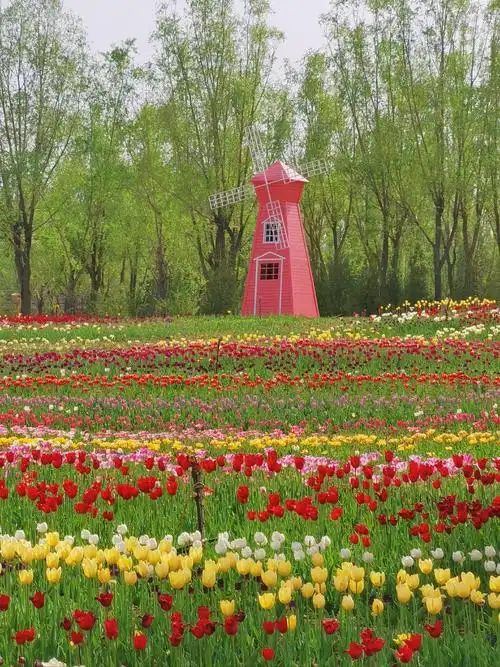
The headline draw is the spring flower season from March through June, when layered plantings of Chinese roses, herbaceous peonies, and Dutch-imported tulips bloom in succession. The centrepiece is a sweeping 5-kilometre rose wall, paired with a tree-rose garden whose sculpted, lollipop-shaped specimens recall the formal parterre traditions of Versailles softened into a romantic English-cottage palette. For flower enthusiasts, the closest Western parallel is the Netherlands' Keukenhof, though Jingmen combines that floral intensity with a broader recreational agenda of picnic lawns, photo pavilions, and seasonal festivals.
Outside the spring window, the park shifts its appeal indoors. A climate-controlled butterfly display hall, a curated bonsai collection, and several glasshouse pavilions sustain the visitor experience year-round, offering an atmosphere reminiscent of London's Kew Gardens' Princess of Wales Conservatory. For an off-season visit, prioritise these glasshouses, the plant-science classrooms in the education zone, and the wedding-themed garden, whose blossom-mountain archways remain photogenic even when the outdoor beds rest between bloom cycles.
General admission to the park grounds is free, though individual attractions, amusement rides, and certain greenhouse experiences carry a separate fee. Opening hours run roughly 9:00 a.m. to 5:30 p.m., with slight extensions in summer; check the official WeChat channel before setting out. Parking is available on-site for a small fee, and a holiday-only shuttle bus connects the park to Jingmen's main urban districts. Electric-cart rentals inside the grounds help cover the long distances, and three to four hours is a comfortable visit length.
Travelers who time their visit for late March through May will find one of central China's most photogenic spring landscapes at a relaxed, uncrowded pace. Photographers, gardening enthusiasts, and families seeking an educational outdoor day will all be well rewarded. In August or other off-peak months, however, outdoor color thins noticeably; focus instead on the indoor exhibitions, bring sunscreen and water, and temper expectations for floral spectacle.
Jingmen sits in the heart of Hubei, a region long associated with the ancient Chu kingdom (荆楚)—one of the most culturally distinctive states of China's Warring States period (475–221 BC), famed for its shamanic poetry, lacquerware, and bronze ritual bells. The Flower Expo Garden, opened in 2020, channels that legacy into its Folk Culture Village, where artisans demonstrate intangible-heritage crafts such as bamboo weaving and traditional paper-cutting. Think of it as a living open-air museum in the spirit of Stockholm's Skansen, but set inside a working horticultural landscape rather than a historic village.
The grounds are organised into six themed zones—a folk culture village, a wedding-themed garden, a leisure and amusement area, a horticulture centre, a science education zone, and a wellness retreat centre—each with its own identity yet visually threaded together by wide, flat pathways and electric-cart shuttles. At roughly 112 hectares, the park is comparable in scale to Paris's Bois de Boulogne but feels distinctly provincial and unhurried. The level terrain and generous lawns make it unusually welcoming for families with strollers, older travelers, and anyone who prefers strolling to climbing.
The headline draw is the spring flower season from March through June, when layered plantings of Chinese roses, herbaceous peonies, and Dutch-imported tulips bloom in succession. The centrepiece is a sweeping 5-kilometre rose wall, paired with a tree-rose garden whose sculpted, lollipop-shaped specimens recall the formal parterre traditions of Versailles softened into a romantic English-cottage palette. For flower enthusiasts, the closest Western parallel is the Netherlands' Keukenhof, though Jingmen combines that floral intensity with a broader recreational agenda of picnic lawns, photo pavilions, and seasonal festivals.
Outside the spring window, the park shifts its appeal indoors. A climate-controlled butterfly display hall, a curated bonsai collection, and several glasshouse pavilions sustain the visitor experience year-round, offering an atmosphere reminiscent of London's Kew Gardens' Princess of Wales Conservatory. For an off-season visit, prioritise these glasshouses, the plant-science classrooms in the education zone, and the wedding-themed garden, whose blossom-mountain archways remain photogenic even when the outdoor beds rest between bloom cycles.
General admission to the park grounds is free, though individual attractions, amusement rides, and certain greenhouse experiences carry a separate fee. Opening hours run roughly 9:00 a.m. to 5:30 p.m., with slight extensions in summer; check the official WeChat channel before setting out. Parking is available on-site for a small fee, and a holiday-only shuttle bus connects the park to Jingmen's main urban districts. Electric-cart rentals inside the grounds help cover the long distances, and three to four hours is a comfortable visit length.
Travelers who time their visit for late March through May will find one of central China's most photogenic spring landscapes at a relaxed, uncrowded pace. Photographers, gardening enthusiasts, and families seeking an educational outdoor day will all be well rewarded. In August or other off-peak months, however, outdoor color thins noticeably; focus instead on the indoor exhibitions, bring sunscreen and water, and temper expectations for floral spectacle.