Longzi Lake Scenic Area
⭐ 3.80
Longzi Lake Scenic Area, Longzi Lake District, Bengbu City, Anhui Province, China
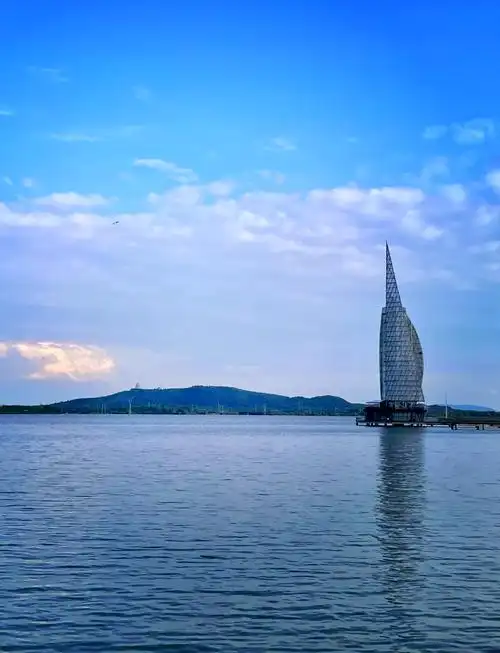 **Setting and Landscape** — Longzi Lake stretches roughly 10 kilometers along a north-south axis, covering 8.4 square kilometers of water ringed by Cao Mountain, Xuehua Mountain, and Xilu Mountain. This "three mountains embracing one lake" configuration is unusually sculpted for the flat terrain of northern Anhui, resembling a Chinese echo of the lake-and-hill compositions found in Italy's Lake District or Austria's Salzkammergut. Vast grassy eastern shores earn the lake its reputation as Bengbu's "green lung," offering city dwellers and travelers alike a refreshing ecological retreat.
**The North-South Divide Monument** — Standing 39.9 meters tall in the western park, the iconic red-and-blue sculpture by celebrated artist Han Meilin physically marks the climatic and geographic boundary dividing northern and southern China. Visitors delight in the ritual of straddling the line, a conceptual cousin to standing astride the Prime Meridian at Greenwich. Surrounding plaza sculptures of auspicious beasts extend the cultural narrative, making this the park's most photographed landmark and a tangible gateway to understanding China's geographic identity.
**The Lakeside Greenway** — A 21-kilometer path loops the lake, suitable for walking, jogging, and cycling, comparable in scale to Copenhagen's harbor loop or London's Regent's Canal towpath. Wooden boardwalks, a rainbow bridge, terraced water cascades, and a sandy beach area punctuate the route. Avid photographers gather at Longhu Bridge's viewing platform at dusk, where backlit waters and the city skyline create striking compositions, while birdwatchers enjoy the eastern woodland habitats in early morning.
**History and Heritage** — The grounds hold the tomb of Tang He, a distinguished Ming-dynasty general who helped found the dynasty in 1368, alongside a thousand-year-old ginkgo tree on Zhui Mountain and a curated folk-village museum. A revolutionary history exhibition hall recalls the region's 20th-century struggles. These layered relics bring the same sense of historical depth that visitors find at England's Warwick Castle grounds or France's Fontainebleau, where natural beauty frames centuries of human story.
**Practical Information** — The scenic area is open daily, year-round, and entirely free of charge, with no timed entry. Self-driving or shared bicycles are the most convenient ways to circle the lake; walkers should reserve at least half a day. Spring and autumn bring the most pleasant weather for cycling, while summer visits require sunscreen and mosquito repellent. Visitors should bring their own water and snacks, as commercial facilities are scattered. Pairing the park with the adjacent Bengbu Museum, just minutes away, offers a richer immersion into Huai River culture and regional history.
**Setting and Landscape** — Longzi Lake stretches roughly 10 kilometers along a north-south axis, covering 8.4 square kilometers of water ringed by Cao Mountain, Xuehua Mountain, and Xilu Mountain. This "three mountains embracing one lake" configuration is unusually sculpted for the flat terrain of northern Anhui, resembling a Chinese echo of the lake-and-hill compositions found in Italy's Lake District or Austria's Salzkammergut. Vast grassy eastern shores earn the lake its reputation as Bengbu's "green lung," offering city dwellers and travelers alike a refreshing ecological retreat.
**The North-South Divide Monument** — Standing 39.9 meters tall in the western park, the iconic red-and-blue sculpture by celebrated artist Han Meilin physically marks the climatic and geographic boundary dividing northern and southern China. Visitors delight in the ritual of straddling the line, a conceptual cousin to standing astride the Prime Meridian at Greenwich. Surrounding plaza sculptures of auspicious beasts extend the cultural narrative, making this the park's most photographed landmark and a tangible gateway to understanding China's geographic identity.
**The Lakeside Greenway** — A 21-kilometer path loops the lake, suitable for walking, jogging, and cycling, comparable in scale to Copenhagen's harbor loop or London's Regent's Canal towpath. Wooden boardwalks, a rainbow bridge, terraced water cascades, and a sandy beach area punctuate the route. Avid photographers gather at Longhu Bridge's viewing platform at dusk, where backlit waters and the city skyline create striking compositions, while birdwatchers enjoy the eastern woodland habitats in early morning.
**History and Heritage** — The grounds hold the tomb of Tang He, a distinguished Ming-dynasty general who helped found the dynasty in 1368, alongside a thousand-year-old ginkgo tree on Zhui Mountain and a curated folk-village museum. A revolutionary history exhibition hall recalls the region's 20th-century struggles. These layered relics bring the same sense of historical depth that visitors find at England's Warwick Castle grounds or France's Fontainebleau, where natural beauty frames centuries of human story.
**Practical Information** — The scenic area is open daily, year-round, and entirely free of charge, with no timed entry. Self-driving or shared bicycles are the most convenient ways to circle the lake; walkers should reserve at least half a day. Spring and autumn bring the most pleasant weather for cycling, while summer visits require sunscreen and mosquito repellent. Visitors should bring their own water and snacks, as commercial facilities are scattered. Pairing the park with the adjacent Bengbu Museum, just minutes away, offers a richer immersion into Huai River culture and regional history.