Mount Tu Scenic Area
⭐ 3.80
Tu Mountain Scenic Area, Yuhui District, Bengbu City, Anhui Province, China
 Mount Tu is the spiritual heartland of China's flood-control mythology, said to be where Yu the Great, a figure as foundational to Chinese civilization as Romulus is to Rome, split the mountains to channel the Huai River and convened the lords of the land around 2000 BCE. The mountain sits precisely on the Qinling–Huai River boundary, a climatic and cultural divide as significant to China as the Alps separating Italy from northern Europe. This dual identity, as both sacred summit and geographic marker, makes it one of the most culturally layered hills in eastern China.
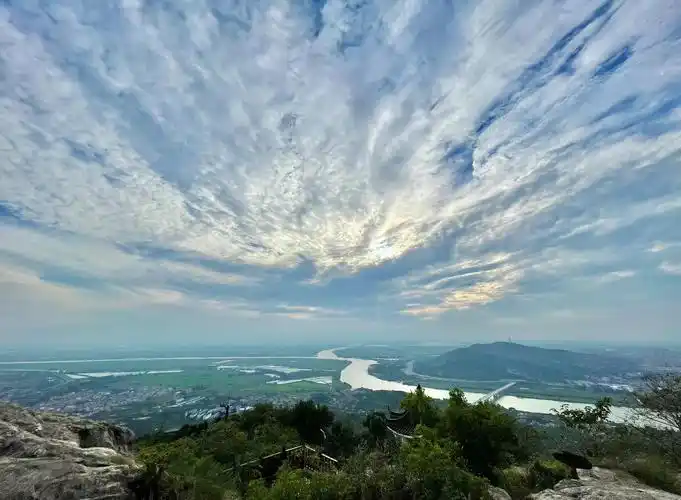
The architectural crown is Yu Wang Palace, founded in 195 BCE and rebuilt through the Han and Tang dynasties, a Taoist complex of layered halls and stone steles that has weathered two millennia on the summit. Comparable in age and devotion to European medieval pilgrimage sites like Montserrat in Spain, its incense-hazed courtyards still honor Yu as the patron of hydraulic engineering. The elegant Wanghuai Pavilion perches over the cliff edge, framing the sweeping gorge where the Huai River cleaves between Mount Tu and Jingshan across the water.
Beyond the temples, Mount Tu pulses with living folk traditions. The annual Temple Fair held around the 28th day of the third lunar month is a provincial-level intangible heritage event, where drum performances, folk dances, and ritual offerings to Yu draw thousands. The Qi Mother Stone nearby preserves a poignant legend of Yu's wife petrified by longing, a motif echoing the Greek tale of Niobe. Below the mountain, the celebrated Bairu Spring was praised by Song dynasty poet Su Shi as the "Seventh Spring Under Heaven," adding a layer of literati heritage.
Geologically, the mountain is a granite dome softened by dense forest cover, its air rich in negative ions and its slopes scattered with over fifty natural features, from the Sleeping Immortal Rock to sacred springs. Spring brings wildflowers, summer offers cool shade, autumn sets the woods ablaze in red and gold, and winter cloaks the ridges in quiet snow. The well-maintained stone steps wind beneath mature trees, making the ascent a gentle rather than strenuous hike.
Reaching Mount Tu is straightforward: buses 302, 303, and 311 serve the entrance, free parking is available, and a sightseeing shuttle climbs to the summit for around ten yuan. The site itself is free, with only the Yu Wang Palace requesting a symbolic five-yuan fee. Allow two to four hours, bring water, wear non-slip shoes for damp stone, and start from the gentle eastern path if traveling with children or elders. The nearby Hequan Farmstead offers farmhouse meals and fruit-picking for a relaxed rural finish to the day.
Climbing Mount Tu rewards visitors with something rare: a direct encounter with the origins of Chinese civilization set against a breathtaking natural landscape. Few places on earth allow you to stand on a tectonic and climatic boundary line, gaze into a gorge sacred to a four-thousand-year-old flood legend, and trace the roots of the hydraulic wisdom that still shapes the nation's identity today.
Mount Tu is the spiritual heartland of China's flood-control mythology, said to be where Yu the Great, a figure as foundational to Chinese civilization as Romulus is to Rome, split the mountains to channel the Huai River and convened the lords of the land around 2000 BCE. The mountain sits precisely on the Qinling–Huai River boundary, a climatic and cultural divide as significant to China as the Alps separating Italy from northern Europe. This dual identity, as both sacred summit and geographic marker, makes it one of the most culturally layered hills in eastern China.
The architectural crown is Yu Wang Palace, founded in 195 BCE and rebuilt through the Han and Tang dynasties, a Taoist complex of layered halls and stone steles that has weathered two millennia on the summit. Comparable in age and devotion to European medieval pilgrimage sites like Montserrat in Spain, its incense-hazed courtyards still honor Yu as the patron of hydraulic engineering. The elegant Wanghuai Pavilion perches over the cliff edge, framing the sweeping gorge where the Huai River cleaves between Mount Tu and Jingshan across the water.
Beyond the temples, Mount Tu pulses with living folk traditions. The annual Temple Fair held around the 28th day of the third lunar month is a provincial-level intangible heritage event, where drum performances, folk dances, and ritual offerings to Yu draw thousands. The Qi Mother Stone nearby preserves a poignant legend of Yu's wife petrified by longing, a motif echoing the Greek tale of Niobe. Below the mountain, the celebrated Bairu Spring was praised by Song dynasty poet Su Shi as the "Seventh Spring Under Heaven," adding a layer of literati heritage.
Geologically, the mountain is a granite dome softened by dense forest cover, its air rich in negative ions and its slopes scattered with over fifty natural features, from the Sleeping Immortal Rock to sacred springs. Spring brings wildflowers, summer offers cool shade, autumn sets the woods ablaze in red and gold, and winter cloaks the ridges in quiet snow. The well-maintained stone steps wind beneath mature trees, making the ascent a gentle rather than strenuous hike.
Reaching Mount Tu is straightforward: buses 302, 303, and 311 serve the entrance, free parking is available, and a sightseeing shuttle climbs to the summit for around ten yuan. The site itself is free, with only the Yu Wang Palace requesting a symbolic five-yuan fee. Allow two to four hours, bring water, wear non-slip shoes for damp stone, and start from the gentle eastern path if traveling with children or elders. The nearby Hequan Farmstead offers farmhouse meals and fruit-picking for a relaxed rural finish to the day.
Climbing Mount Tu rewards visitors with something rare: a direct encounter with the origins of Chinese civilization set against a breathtaking natural landscape. Few places on earth allow you to stand on a tectonic and climatic boundary line, gaze into a gorge sacred to a four-thousand-year-old flood legend, and trace the roots of the hydraulic wisdom that still shapes the nation's identity today.