Baiyangdian Scenic Area
⭐ 4.60
Anxin County, Xiongan New Area, Hebei Province, China
 Baiyangdian's origins stretch back several millennia, when it was known as "Jueli Dian" and gradually evolved into the rare freshwater sanctuary it remains today. Its cultural footprint grew enormously in the mid-twentieth century, when writer Sun Li founded the "Lotus Lake School" of literature here, producing beloved works like "Lotus Lake" and "Chronicles of Baiyangdian" that remain fixtures of Chinese classrooms. During the Second Sino-Japanese War, the wetland became a stage for fierce resistance: the Yanling Brigade, named for the wild geese that nested in the reeds, used the labyrinthine channels to ambush Japanese forces—much as partisan fighters exploited similar marshlands across war-torn Europe. Their legacy is preserved in the Yanling Brigade Memorial Hall and the recreated "Gazi Village" from the classic film "Little Soldier Zhang Ga."
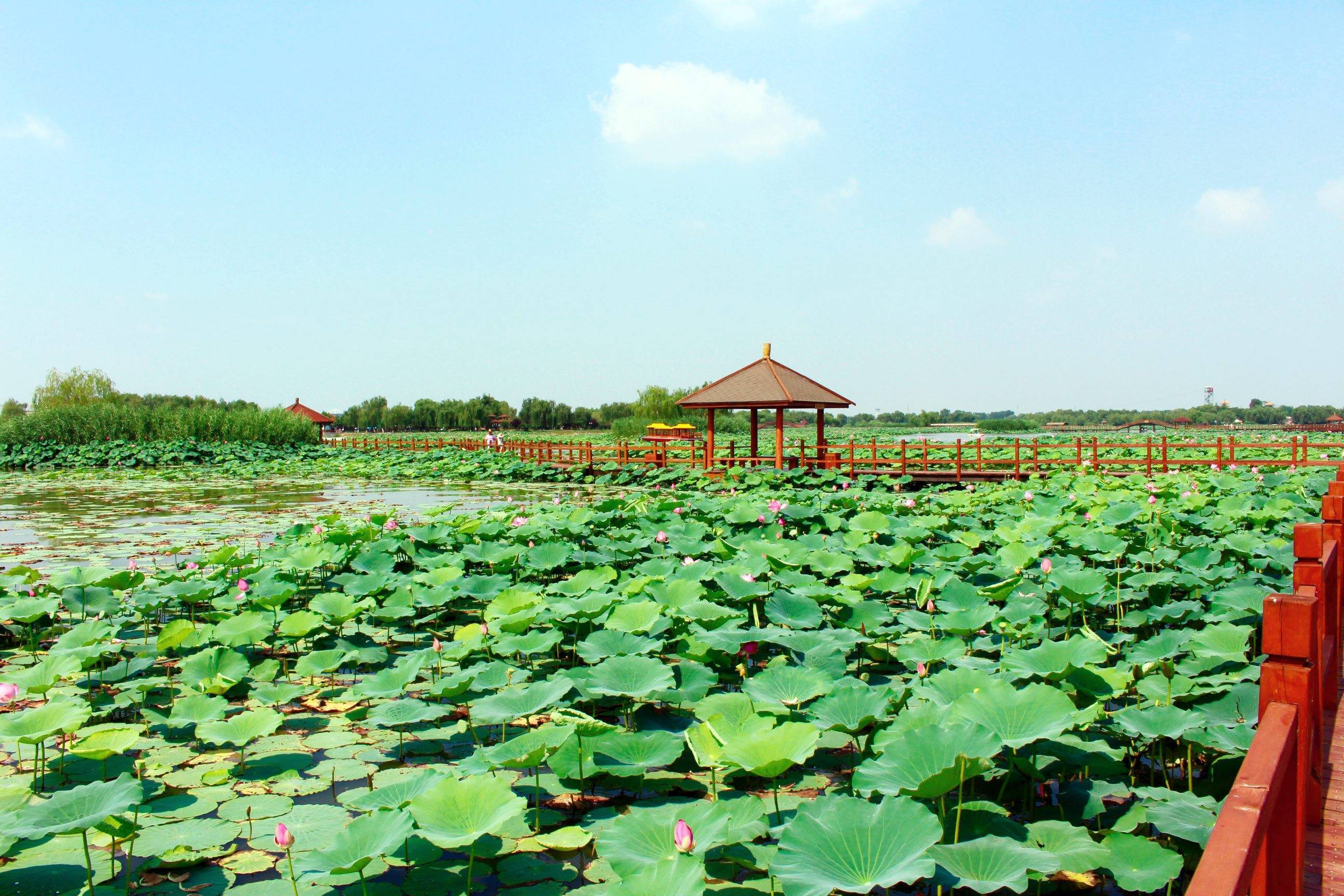
The wetland's geography is its signature feature: 143 separate lake basins stitched together by 27 square kilometers of navigable waterways, bordered by countless hectares of towering reeds that form natural mazes. From mid-July through August, the Lotus Grand View Garden explodes with color as 300-plus lotus varieties bloom in sequence, including rare "thousand-petal" and "twin-blossom" specimens. Autumn transforms the reeds into silver-white "flying snow," with migratory birds gathering in great numbers; winter freezes the surface into a still, crystalline mirror of the surrounding countryside.
The Cultural Garden anchors the historical side of any visit. Here, the Kangxi Emperor's eighteenth-century waterside hunting palace, the imperial-bestowed Pei'en Temple, and the Yanling Brigade Memorial create an itinerary that mirrors the layered histories of European palace complexes like Blenheim or Sanssouci—though scaled to a more intimate wetland setting. A daily outdoor performance, "Gazi's Impression," dramatizes the wartime exploits using the reed channels as a natural amphitheater, blending theater with the landscape in a manner reminiscent of historical reenactments at medieval festivals across Britain and Germany.
Local culture runs deep. The 1,000-year-old Quantou Village Music Association, centered on traditional sheng and flute ensembles, has earned designation as national intangible cultural heritage. Cuisine reflects the water itself: the celebrated whole-fish banquet features freshly caught carp and crucian simmered with cornbread, salted duck eggs from the reed beds, lotus-root dishes, shrimp pancakes, and eggs scrambled with young lotus leaves. A cup of lotus-leaf tea, brewed from leaves gathered that morning, captures the wetland's essence in a single aromatic sip—much like a fine mezcal speaks of its Mexican terroir.
Practical planning is straightforward. Entry requires advance booking through the official WeChat mini-program, with combined boat and attraction tickets averaging 150 RMB per person. Allow one to two days; the classic route runs from the main dock by boat to the Lotus Grand View Garden, then onward to the Cultural Garden, finishing with the evening "Gazi" performance. August visitors should pack sunscreen and mosquito repellent, while life jackets are mandatory aboard all vessels—weather can shift quickly, so check forecasts and avoid stormy afternoons. The wetland lies within a three-hour drive of Beijing and Tianjin, and high-speed rail connections via Baoding East or Xiongan stations make independent access easy.
Baiyangdian's origins stretch back several millennia, when it was known as "Jueli Dian" and gradually evolved into the rare freshwater sanctuary it remains today. Its cultural footprint grew enormously in the mid-twentieth century, when writer Sun Li founded the "Lotus Lake School" of literature here, producing beloved works like "Lotus Lake" and "Chronicles of Baiyangdian" that remain fixtures of Chinese classrooms. During the Second Sino-Japanese War, the wetland became a stage for fierce resistance: the Yanling Brigade, named for the wild geese that nested in the reeds, used the labyrinthine channels to ambush Japanese forces—much as partisan fighters exploited similar marshlands across war-torn Europe. Their legacy is preserved in the Yanling Brigade Memorial Hall and the recreated "Gazi Village" from the classic film "Little Soldier Zhang Ga."
The wetland's geography is its signature feature: 143 separate lake basins stitched together by 27 square kilometers of navigable waterways, bordered by countless hectares of towering reeds that form natural mazes. From mid-July through August, the Lotus Grand View Garden explodes with color as 300-plus lotus varieties bloom in sequence, including rare "thousand-petal" and "twin-blossom" specimens. Autumn transforms the reeds into silver-white "flying snow," with migratory birds gathering in great numbers; winter freezes the surface into a still, crystalline mirror of the surrounding countryside.
The Cultural Garden anchors the historical side of any visit. Here, the Kangxi Emperor's eighteenth-century waterside hunting palace, the imperial-bestowed Pei'en Temple, and the Yanling Brigade Memorial create an itinerary that mirrors the layered histories of European palace complexes like Blenheim or Sanssouci—though scaled to a more intimate wetland setting. A daily outdoor performance, "Gazi's Impression," dramatizes the wartime exploits using the reed channels as a natural amphitheater, blending theater with the landscape in a manner reminiscent of historical reenactments at medieval festivals across Britain and Germany.
Local culture runs deep. The 1,000-year-old Quantou Village Music Association, centered on traditional sheng and flute ensembles, has earned designation as national intangible cultural heritage. Cuisine reflects the water itself: the celebrated whole-fish banquet features freshly caught carp and crucian simmered with cornbread, salted duck eggs from the reed beds, lotus-root dishes, shrimp pancakes, and eggs scrambled with young lotus leaves. A cup of lotus-leaf tea, brewed from leaves gathered that morning, captures the wetland's essence in a single aromatic sip—much like a fine mezcal speaks of its Mexican terroir.
Practical planning is straightforward. Entry requires advance booking through the official WeChat mini-program, with combined boat and attraction tickets averaging 150 RMB per person. Allow one to two days; the classic route runs from the main dock by boat to the Lotus Grand View Garden, then onward to the Cultural Garden, finishing with the evening "Gazi" performance. August visitors should pack sunscreen and mosquito repellent, while life jackets are mandatory aboard all vessels—weather can shift quickly, so check forecasts and avoid stormy afternoons. The wetland lies within a three-hour drive of Beijing and Tianjin, and high-speed rail connections via Baoding East or Xiongan stations make independent access easy.