Caozhou Ancient City
⭐ 3.60
Caozhou Ancient City, Mudan District, Heze, Shandong, China
 The site takes its cues from Caozhou's Ming-era city plan of the 1440s, when the Yongle and Zhengtong emperors consolidated administration across Shandong. While European contemporaries were designing Renaissance "ideal cities" such as Palmanova in Italy with their geometric bastions, Chinese planners favored the classic "square within, circle without" cosmological layout—a scheme meant to harmonize earthly order with heavenly roundness. Today the district revives this geometry around Youth Lake, offering visitors a contemporary window onto late-imperial urbanism without leaving the twenty-first century.
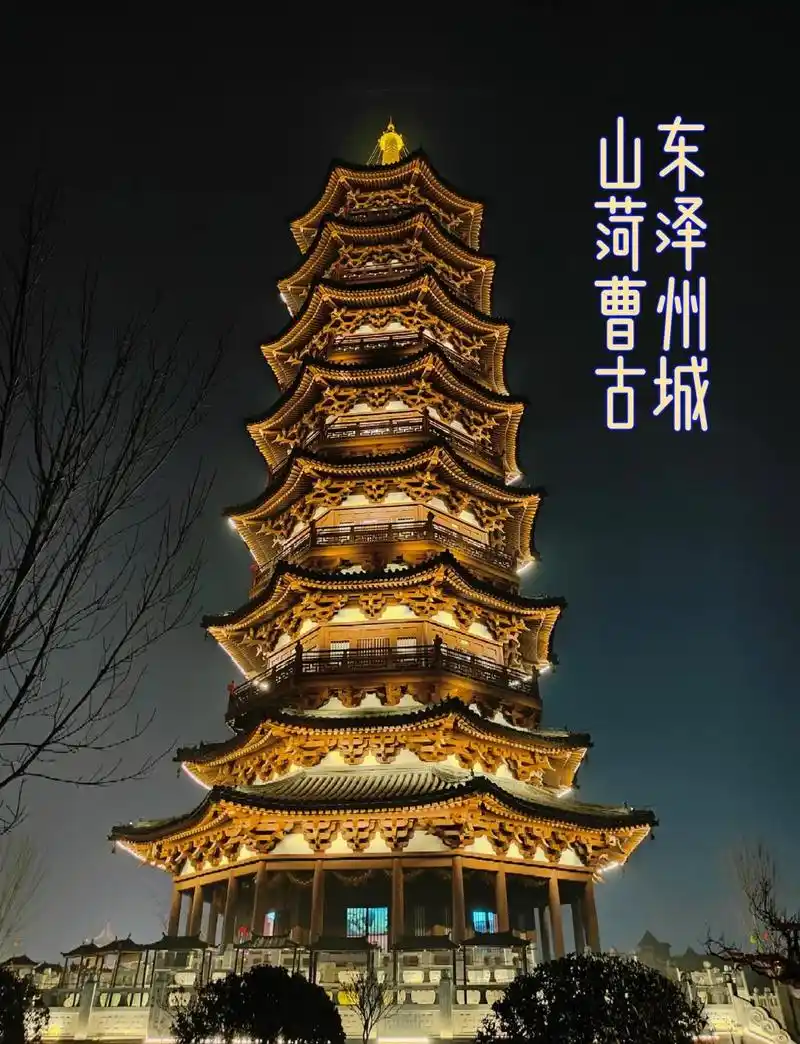
Yong'an Pagoda anchors the skyline: a seven-tier octagonal timber-frame tower reminiscent of Song-dynasty prototypes, its layered eaves recalling Italian Romanesque campaniles. Climbable for a small fee, it rewards visitors with sunset views over the former moat. Nearby stands the Guandi Temple, honoring the deified general Guan Yu—revered across East Asia much as Saint George is in the West. The transplanted Shensi Garden, with whitewashed walls, grey tiles, and elegant covered walkways, channels the UNESCO-listed Suzhou garden tradition, comparable in spirit to the intimate courtyards of a Roman villa or an Oxford college close.
The cultural program is the area's heartbeat. On weekends and holidays, performers stage Hanfu processions, shadow puppetry, and other Shandong intangible heritage. The signature spectacle, however, is tiehua—iron-flower throwing—where artisans fling molten metal at roughly 1,600°C into the night sky, producing golden cascades that rival any European fireworks finale or Las Vegas pyrotechnic show. Hanfu rental and styling services let visitors step into costume themselves, while a recreated ancient market offers hands-on demonstrations of Lu brocade weaving and clay figurines.
Named for the Ming-era founding date, the 1446 Block gathers southwestern Shandong flavors in a single stroll. Sample Caozhou braised beef, Shanxian lamb broth in handmade bowls, pan-fried buns, and the hearty flatbread called zhuangmo. Pair these with local beer or tea, then browse shops selling brocade, paper cuttings, and dough figurines—souvenirs distinct from generic Chinese trinkets. The compact layout suits a relaxed half-day tasting tour, with shaded benches for resting between stops.
Entry is free year-round; indoor venues such as Shensi Garden open 10:00–18:00. From Heze's airport or high-speed rail station, a taxi reaches the site in 20–30 minutes, and several city buses serve the area. Allow two to three hours; arrive around 17:30 to catch daylight photographs, then linger for the 18:30 lighting switch-on. Note that all structures are modern reconstructions—visitors seeking authentic patina should temper expectations. Weekday visits see fewer performances, so check the official noticeboard before traveling.
Caozhou Ancient City forms the evening counterpart to Heze's daytime draw: the world-famous Peony Gardens, which bloom gloriously in late April and May. Pairing the two illuminates both the natural and cultural life of this "Peony Capital." Together with the Heze City Museum's archaeological collections, travelers can assemble a satisfying two-day itinerary for one of Shandong's most underrated corners—an accessible detour between the Confucian heritage of Qufu and the canal-side charms of nearby Jining.
The site takes its cues from Caozhou's Ming-era city plan of the 1440s, when the Yongle and Zhengtong emperors consolidated administration across Shandong. While European contemporaries were designing Renaissance "ideal cities" such as Palmanova in Italy with their geometric bastions, Chinese planners favored the classic "square within, circle without" cosmological layout—a scheme meant to harmonize earthly order with heavenly roundness. Today the district revives this geometry around Youth Lake, offering visitors a contemporary window onto late-imperial urbanism without leaving the twenty-first century.
Yong'an Pagoda anchors the skyline: a seven-tier octagonal timber-frame tower reminiscent of Song-dynasty prototypes, its layered eaves recalling Italian Romanesque campaniles. Climbable for a small fee, it rewards visitors with sunset views over the former moat. Nearby stands the Guandi Temple, honoring the deified general Guan Yu—revered across East Asia much as Saint George is in the West. The transplanted Shensi Garden, with whitewashed walls, grey tiles, and elegant covered walkways, channels the UNESCO-listed Suzhou garden tradition, comparable in spirit to the intimate courtyards of a Roman villa or an Oxford college close.
The cultural program is the area's heartbeat. On weekends and holidays, performers stage Hanfu processions, shadow puppetry, and other Shandong intangible heritage. The signature spectacle, however, is tiehua—iron-flower throwing—where artisans fling molten metal at roughly 1,600°C into the night sky, producing golden cascades that rival any European fireworks finale or Las Vegas pyrotechnic show. Hanfu rental and styling services let visitors step into costume themselves, while a recreated ancient market offers hands-on demonstrations of Lu brocade weaving and clay figurines.
Named for the Ming-era founding date, the 1446 Block gathers southwestern Shandong flavors in a single stroll. Sample Caozhou braised beef, Shanxian lamb broth in handmade bowls, pan-fried buns, and the hearty flatbread called zhuangmo. Pair these with local beer or tea, then browse shops selling brocade, paper cuttings, and dough figurines—souvenirs distinct from generic Chinese trinkets. The compact layout suits a relaxed half-day tasting tour, with shaded benches for resting between stops.
Entry is free year-round; indoor venues such as Shensi Garden open 10:00–18:00. From Heze's airport or high-speed rail station, a taxi reaches the site in 20–30 minutes, and several city buses serve the area. Allow two to three hours; arrive around 17:30 to catch daylight photographs, then linger for the 18:30 lighting switch-on. Note that all structures are modern reconstructions—visitors seeking authentic patina should temper expectations. Weekday visits see fewer performances, so check the official noticeboard before traveling.
Caozhou Ancient City forms the evening counterpart to Heze's daytime draw: the world-famous Peony Gardens, which bloom gloriously in late April and May. Pairing the two illuminates both the natural and cultural life of this "Peony Capital." Together with the Heze City Museum's archaeological collections, travelers can assemble a satisfying two-day itinerary for one of Shandong's most underrated corners—an accessible detour between the Confucian heritage of Qufu and the canal-side charms of nearby Jining.