Taihui Temple
⭐ 3.20
Taihui Temple, Jingzhou District, Jingzhou City, Hubei Province, China
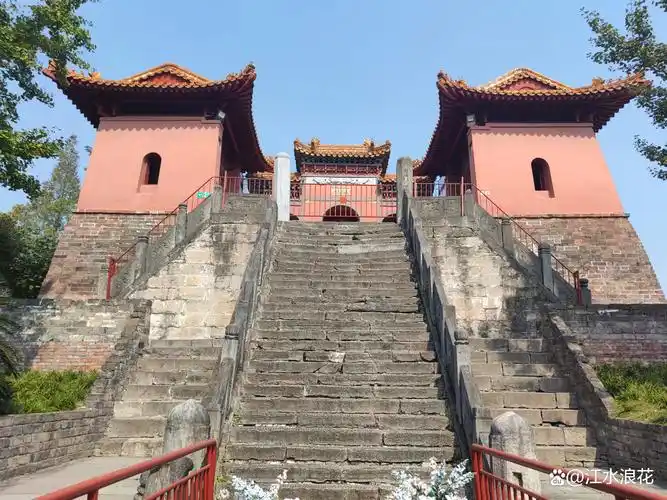 Taihui Temple was founded in 1393, just as the newly established Ming Dynasty was consolidating power under its founding emperor Zhu Yuanzhang—roughly contemporary with the Plantagenet kings of England and the closing years of Europe's Hundred Years' War. The site began as the palatial residence of the emperor's twelfth son, Prince Zhu Bai, known as the Prince of Xiang. When imperial censors deemed the residence too grand for a vassal prince, it was rededicated as a Daoist sanctuary. The site carries a dark historical footnote: in 1399, Prince Zhu Bai perished in the flames of his own palace during the chaotic Jingnan Rebellion, a civil war that pitted uncle against nephew in a succession struggle reminiscent of England's Wars of the Roses.
The complex climbs the slope of Taihui Hill in classic Chinese sacred-mountain style, much as a European pilgrimage chapel might perch above an Italian hill town. Worshippers must ascend 32 stone steps to reach the Gate of Pilgrimage, beyond which the main halls line up along a central axis. The whole complex rises on a stone platform 8.2 meters high—a deliberate feat of Ming engineering that gives Taihui Temple the most commanding presence among Jingzhou's "Three Temples." Subsidiary halls dedicated to the Medicine King, Guanyin, and the God of Literature flank the principal structures, embodying the eclectic spiritual traditions that flourished under early Ming patronage.
Three artistic treasures earn Taihui Temple its reputation. The Patriarch Hall earns its nickname "Little Golden Summit" from copper tiles that gleam gold when sunlight strikes them—one of the very few Ming-era copper-tiled halls surviving in Hubei. Flanking the hall, six of twelve octagonal stone columns feature dragons carved in high relief, their fierce heads projecting outward as if straining toward heaven. Around the walls, some 500 individual brick carvings of Lingguan guardian deities display astonishing variety—comparable in ambition, though different in style, to the sculpted portals of medieval European cathedrals such as Chartres or Reims.
Taihui Temple is a rare surviving example of the architectural fusion between early Ming princely residences and Daoist sacred space. Its three signature features—the copper-tiled roof, the dragon pillars, and the Lingguan brick carvings—offer scholars an unusually complete picture of late-14th-century craftsmanship and imperial Daoist aesthetics. As a National Key Cultural Relics Protection Unit, the site provides invaluable physical evidence for studying Ming vassal-prince governance, the evolution of Daoist architecture, and the tragic biography of Prince Zhu Bai. For travelers interested in Chinese imperial history or sacred architecture, it ranks as one of central China's most rewarding off-the-beaten-path visits.
Taihui Temple sits at 262 Xihuan Road in Jingzhou District, roughly 3.2 kilometers west of the city center and easily reached by bus 26 or a short taxi ride. Entrance is typically free, with daily opening hours running from 7:00 a.m. to 5:00 p.m. There are no shops, restaurants, or restrooms within the grounds, so visitors should bring their own water. As the temple remains an active Daoist worship site, modest behavior is expected—avoid flash photography of the deity statues and step respectfully around worshippers at prayer. The visit itself takes only 30 to 45 minutes, as the complex is compact but visually dense.
While the temple is small, its compact footprint rewards travelers who linger over carving details rather than rush through. Because the site lacks tourist infrastructure and sits a little outside the urban core, the most satisfying way to visit is to combine it with Jingzhou's two great historic attractions: the Jingzhou Museum, whose collections span the ancient Chu kingdom and the Warring States period, and the remarkably intact Ming-era city wall that still encircles the old town. A single day pairing Taihui Temple with these two neighbors offers a complete survey of Hubei's layered past—from the Bronze Age to the height of imperial Ming.
Taihui Temple was founded in 1393, just as the newly established Ming Dynasty was consolidating power under its founding emperor Zhu Yuanzhang—roughly contemporary with the Plantagenet kings of England and the closing years of Europe's Hundred Years' War. The site began as the palatial residence of the emperor's twelfth son, Prince Zhu Bai, known as the Prince of Xiang. When imperial censors deemed the residence too grand for a vassal prince, it was rededicated as a Daoist sanctuary. The site carries a dark historical footnote: in 1399, Prince Zhu Bai perished in the flames of his own palace during the chaotic Jingnan Rebellion, a civil war that pitted uncle against nephew in a succession struggle reminiscent of England's Wars of the Roses.
The complex climbs the slope of Taihui Hill in classic Chinese sacred-mountain style, much as a European pilgrimage chapel might perch above an Italian hill town. Worshippers must ascend 32 stone steps to reach the Gate of Pilgrimage, beyond which the main halls line up along a central axis. The whole complex rises on a stone platform 8.2 meters high—a deliberate feat of Ming engineering that gives Taihui Temple the most commanding presence among Jingzhou's "Three Temples." Subsidiary halls dedicated to the Medicine King, Guanyin, and the God of Literature flank the principal structures, embodying the eclectic spiritual traditions that flourished under early Ming patronage.
Three artistic treasures earn Taihui Temple its reputation. The Patriarch Hall earns its nickname "Little Golden Summit" from copper tiles that gleam gold when sunlight strikes them—one of the very few Ming-era copper-tiled halls surviving in Hubei. Flanking the hall, six of twelve octagonal stone columns feature dragons carved in high relief, their fierce heads projecting outward as if straining toward heaven. Around the walls, some 500 individual brick carvings of Lingguan guardian deities display astonishing variety—comparable in ambition, though different in style, to the sculpted portals of medieval European cathedrals such as Chartres or Reims.
Taihui Temple is a rare surviving example of the architectural fusion between early Ming princely residences and Daoist sacred space. Its three signature features—the copper-tiled roof, the dragon pillars, and the Lingguan brick carvings—offer scholars an unusually complete picture of late-14th-century craftsmanship and imperial Daoist aesthetics. As a National Key Cultural Relics Protection Unit, the site provides invaluable physical evidence for studying Ming vassal-prince governance, the evolution of Daoist architecture, and the tragic biography of Prince Zhu Bai. For travelers interested in Chinese imperial history or sacred architecture, it ranks as one of central China's most rewarding off-the-beaten-path visits.
Taihui Temple sits at 262 Xihuan Road in Jingzhou District, roughly 3.2 kilometers west of the city center and easily reached by bus 26 or a short taxi ride. Entrance is typically free, with daily opening hours running from 7:00 a.m. to 5:00 p.m. There are no shops, restaurants, or restrooms within the grounds, so visitors should bring their own water. As the temple remains an active Daoist worship site, modest behavior is expected—avoid flash photography of the deity statues and step respectfully around worshippers at prayer. The visit itself takes only 30 to 45 minutes, as the complex is compact but visually dense.
While the temple is small, its compact footprint rewards travelers who linger over carving details rather than rush through. Because the site lacks tourist infrastructure and sits a little outside the urban core, the most satisfying way to visit is to combine it with Jingzhou's two great historic attractions: the Jingzhou Museum, whose collections span the ancient Chu kingdom and the Warring States period, and the remarkably intact Ming-era city wall that still encircles the old town. A single day pairing Taihui Temple with these two neighbors offers a complete survey of Hubei's layered past—from the Bronze Age to the height of imperial Ming.