Chengde Guandi Temple
⭐ 3.60
East Section of Yuemiao Street, Chengde, Hebei, China
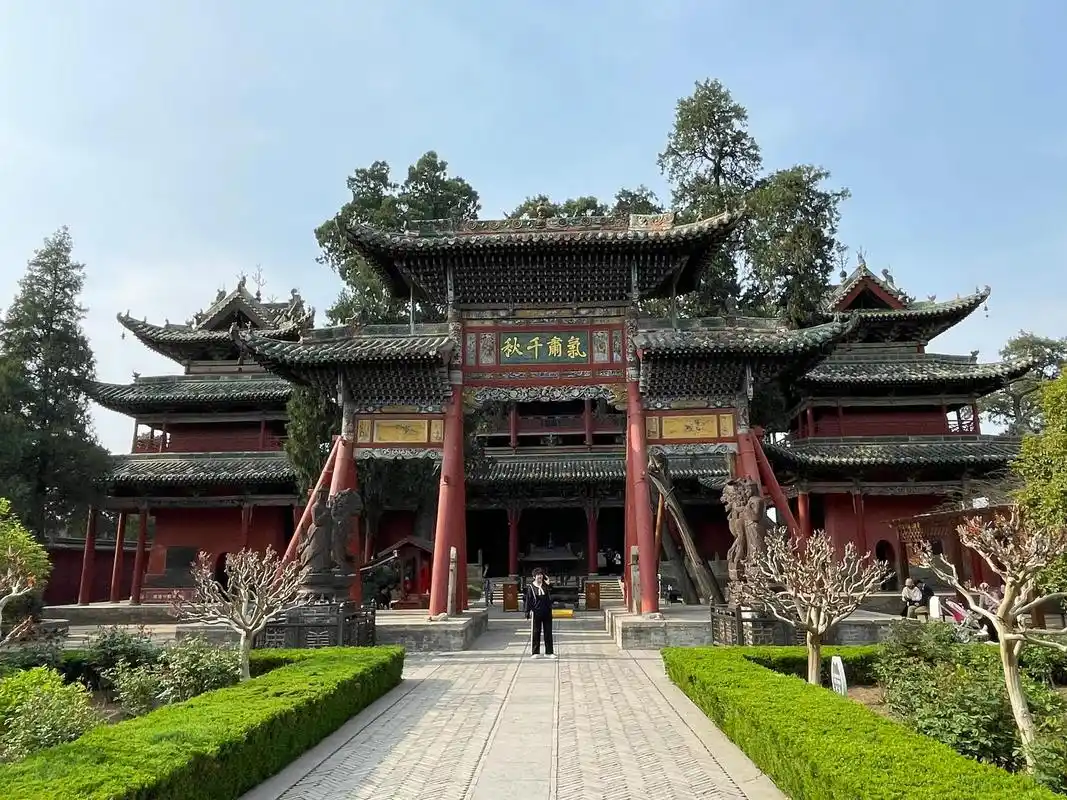 Guan Yu, the crimson-faced general immortalized in the 14th-century novel *Romance of the Three Kingdoms*, became a deity of war, loyalty, and righteousness worshipped across East Asia for centuries. While shrines to him dot China, the Chengde temple holds singular status: it is the only one commissioned by the imperial court itself. Erected during the Yongzheng era as part of Emperor Kangxi's grand vision for Chengde—a northern retreat rivaling Versailles in scale and ambition—the temple served as a sacred stop where emperors worshipped while away from Beijing. In 1778, Qianlong elevated it with yellow-glazed roof tiles, the exclusive chromatic signature of imperial buildings, much as gold leaf once marked Habsburg palaces or the Vatican's sacred interiors.
The temple occupies roughly 3,500 square meters and, after a 2002 restoration, preserves more than twenty halls, including the Chongsheng Hall, the Sanqing Hall dedicated to Daoist deities, and side halls honoring folk gods of medicine and wealth. The Chongsheng Hall dazzles with its imperial-yellow *xieshan* (hipped-gable) roof and sumptuous *tiekujin* gilded-beam paintings—a decorative technique akin to Europe's baroque gilding—where every square inch of timber is brushed in gold leaf against painted dragons and clouds. Red walls, golden tiles, and intricately carved bracket sets create a visual rhythm that echoes the harmony of Chinese cosmology.
Culturally, the temple is a remarkable artifact of Qing pluralism. A bilingual Manchu-Chinese stele, erected by Qianlong himself, recounts Guan's mythic deeds and traces his elevation to "Saint of War," making it invaluable for scholars of Qing history and Sino-Manchu cultural fusion. Its layout embodies a Confucian-Buddhist-Daoist trinity: the Confucian hero Guan at the center, flanked by Daoist immortals and folk deities—a syncretic arrangement comparable to the interfaith sanctuaries of medieval Europe, where patron saints, local spirits, and universal creeds coexisted under one roof.
Practical details make visiting effortless. The temple sits at 18 Lizhengmen Street, a mere twenty-meter stroll from the Lizhengmen gate of the Mountain Resort. Adult admission runs just 17–20 yuan, with discounts for seniors and children. Summer hours stretch from 7:30 a.m. to 7:00 p.m., while winter visitors should arrive between 8:30 a.m. and 5:30 p.m. Hiring the on-site guide is highly recommended; their insights bring the stele inscriptions and architectural symbolism vividly to life.
Plan to spend 40–60 minutes exploring, ideally between late morning and early afternoon. A perfect cultural circuit pairs the temple with the Mountain Resort in the morning and the nearby Putuo Zongcheng Lamasery—often called the "Little Potala"—in the afternoon, tracing a seamless arc from Han Chinese imperial garden to martial shrine to Tibetan Buddhist mountaintop palace. Visitors should dress modestly, step over rather than on door thresholds, and keep voices low to honor the temple's continuing spiritual atmosphere.
Guan Yu, the crimson-faced general immortalized in the 14th-century novel *Romance of the Three Kingdoms*, became a deity of war, loyalty, and righteousness worshipped across East Asia for centuries. While shrines to him dot China, the Chengde temple holds singular status: it is the only one commissioned by the imperial court itself. Erected during the Yongzheng era as part of Emperor Kangxi's grand vision for Chengde—a northern retreat rivaling Versailles in scale and ambition—the temple served as a sacred stop where emperors worshipped while away from Beijing. In 1778, Qianlong elevated it with yellow-glazed roof tiles, the exclusive chromatic signature of imperial buildings, much as gold leaf once marked Habsburg palaces or the Vatican's sacred interiors.
The temple occupies roughly 3,500 square meters and, after a 2002 restoration, preserves more than twenty halls, including the Chongsheng Hall, the Sanqing Hall dedicated to Daoist deities, and side halls honoring folk gods of medicine and wealth. The Chongsheng Hall dazzles with its imperial-yellow *xieshan* (hipped-gable) roof and sumptuous *tiekujin* gilded-beam paintings—a decorative technique akin to Europe's baroque gilding—where every square inch of timber is brushed in gold leaf against painted dragons and clouds. Red walls, golden tiles, and intricately carved bracket sets create a visual rhythm that echoes the harmony of Chinese cosmology.
Culturally, the temple is a remarkable artifact of Qing pluralism. A bilingual Manchu-Chinese stele, erected by Qianlong himself, recounts Guan's mythic deeds and traces his elevation to "Saint of War," making it invaluable for scholars of Qing history and Sino-Manchu cultural fusion. Its layout embodies a Confucian-Buddhist-Daoist trinity: the Confucian hero Guan at the center, flanked by Daoist immortals and folk deities—a syncretic arrangement comparable to the interfaith sanctuaries of medieval Europe, where patron saints, local spirits, and universal creeds coexisted under one roof.
Practical details make visiting effortless. The temple sits at 18 Lizhengmen Street, a mere twenty-meter stroll from the Lizhengmen gate of the Mountain Resort. Adult admission runs just 17–20 yuan, with discounts for seniors and children. Summer hours stretch from 7:30 a.m. to 7:00 p.m., while winter visitors should arrive between 8:30 a.m. and 5:30 p.m. Hiring the on-site guide is highly recommended; their insights bring the stele inscriptions and architectural symbolism vividly to life.
Plan to spend 40–60 minutes exploring, ideally between late morning and early afternoon. A perfect cultural circuit pairs the temple with the Mountain Resort in the morning and the nearby Putuo Zongcheng Lamasery—often called the "Little Potala"—in the afternoon, tracing a seamless arc from Han Chinese imperial garden to martial shrine to Tibetan Buddhist mountaintop palace. Visitors should dress modestly, step over rather than on door thresholds, and keep voices low to honor the temple's continuing spiritual atmosphere.