Ancient Lotus Pond
⭐ 4.00
Ancient Lotus Pond, Lianchi District, Baoding, Hebei, China
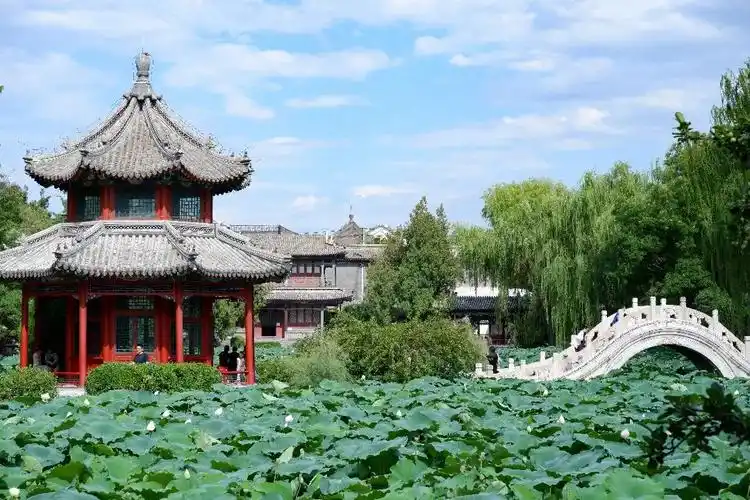 Founded in 1227—the year Genghis Khan died and his empire was being carved among his heirs—Ancient Lotus Pond was originally laid out as a private villa by Zhang Rou, a general who served the Jin dynasty before submitting to the Mongols. The garden predates most famous European landscapes: Versailles would not exist for another five centuries, while Hadrian's Villa at Tivoli was already a ruin. Over the following 800 years it witnessed the rise and fall of three dynasties, serving both as an imperial waystation and a Confucian academy—a continuity of use almost unmatched in world garden history.
Covering about 32,000 square meters with nearly 8,000 square meters of water, the garden centers on its lotus pond, borrowing scenery from artificial hills in a manner reminiscent of Italian Renaissance villa landscapes like Villa d'Este. Yuan-dynasty authenticity survives in the Twelve-Connected Bridge spanning the waters and in the ingenious rockeries of Chunwu Slope and the Lüye Stepped Bridge. Pavilions including the Shuixiang Tower and Xiangqin Pavilion create carefully composed vistas where every turn reveals a new framed scene—a principle Chinese gardeners call "step-shifting, view-changing."
The Lotus Pond Academy flourished during the Qing era as one of northern China's leading centers of learning, drawing scholars who shaped imperial policy—much as Oxford or the Sorbonne influenced European intellectual life. The Stele Corridor displays calligraphy treasures spanning dynasties, including an imperial "Flying Dragon" inscription by the Kangxi Emperor himself. Poets and emperors left verses carved into stone throughout the grounds, transforming the garden into a three-dimensional library of Chinese literary and artistic heritage.
The site holds a national AAAA rating and operates jointly with the Lotus Pond Academy Museum. Located at 246 Yuhua West Road in Baoding's Lianchi District, it opens 8:30–19:30 in peak season and 9:00–17:30 otherwise, closed Mondays except holidays. Admission is 30 yuan for adults, half-price for students, and free for seniors over 60 and military personnel. Call 0312-2032097 to confirm. The visitor center offers luggage storage, wheelchair rental, and power-bank rentals.
Plan 1.5 to 2 hours, entering through the main gate and following the suggested route: Stele Corridor, Academy Museum, central lakeside pavilion, Shuixiang Tower, and bamboo grove path. June and July bring peak lotus bloom, though early mornings from 8:30 to 10:30 reward visitors with soft light and fewer crowds. Wear flat, non-slip shoes for the stone paving. Just a five-minute walk away stands the Zhili Governor-General Office, making it easy to combine both sites into a rich half-day cultural immersion—an experience that connects travelers to centuries of Chinese history in ways no European landmark can quite replicate.
Founded in 1227—the year Genghis Khan died and his empire was being carved among his heirs—Ancient Lotus Pond was originally laid out as a private villa by Zhang Rou, a general who served the Jin dynasty before submitting to the Mongols. The garden predates most famous European landscapes: Versailles would not exist for another five centuries, while Hadrian's Villa at Tivoli was already a ruin. Over the following 800 years it witnessed the rise and fall of three dynasties, serving both as an imperial waystation and a Confucian academy—a continuity of use almost unmatched in world garden history.
Covering about 32,000 square meters with nearly 8,000 square meters of water, the garden centers on its lotus pond, borrowing scenery from artificial hills in a manner reminiscent of Italian Renaissance villa landscapes like Villa d'Este. Yuan-dynasty authenticity survives in the Twelve-Connected Bridge spanning the waters and in the ingenious rockeries of Chunwu Slope and the Lüye Stepped Bridge. Pavilions including the Shuixiang Tower and Xiangqin Pavilion create carefully composed vistas where every turn reveals a new framed scene—a principle Chinese gardeners call "step-shifting, view-changing."
The Lotus Pond Academy flourished during the Qing era as one of northern China's leading centers of learning, drawing scholars who shaped imperial policy—much as Oxford or the Sorbonne influenced European intellectual life. The Stele Corridor displays calligraphy treasures spanning dynasties, including an imperial "Flying Dragon" inscription by the Kangxi Emperor himself. Poets and emperors left verses carved into stone throughout the grounds, transforming the garden into a three-dimensional library of Chinese literary and artistic heritage.
The site holds a national AAAA rating and operates jointly with the Lotus Pond Academy Museum. Located at 246 Yuhua West Road in Baoding's Lianchi District, it opens 8:30–19:30 in peak season and 9:00–17:30 otherwise, closed Mondays except holidays. Admission is 30 yuan for adults, half-price for students, and free for seniors over 60 and military personnel. Call 0312-2032097 to confirm. The visitor center offers luggage storage, wheelchair rental, and power-bank rentals.
Plan 1.5 to 2 hours, entering through the main gate and following the suggested route: Stele Corridor, Academy Museum, central lakeside pavilion, Shuixiang Tower, and bamboo grove path. June and July bring peak lotus bloom, though early mornings from 8:30 to 10:30 reward visitors with soft light and fewer crowds. Wear flat, non-slip shoes for the stone paving. Just a five-minute walk away stands the Zhili Governor-General Office, making it easy to combine both sites into a rich half-day cultural immersion—an experience that connects travelers to centuries of Chinese history in ways no European landmark can quite replicate.