Wuhu Yangtze River Bridge
⭐ 2.50
Wuhu Yangtze River Bridge, Jinghu District, Wuhu, Anhui, China
 When Wuhu Yangtze River Bridge opened in September 2000, it ended an era stretching back centuries—when crossing the Yangtze near this stretch of Anhui meant queuing for ferries that were frequently suspended by winter fogs and summer floods. The bridge was a flagship of China's "Ninth Five-Year Plan," the same kind of state-driven industrial ambition that produced Europe's great railway age in the nineteenth century. For Western visitors, the moment is reminiscent of the Tyne Bridge opening in Newcastle or the Forth Road Bridge transforming Scottish life: a piece of steelwork that turns two riverbanks into one community, and a region into a player on the continental stage.
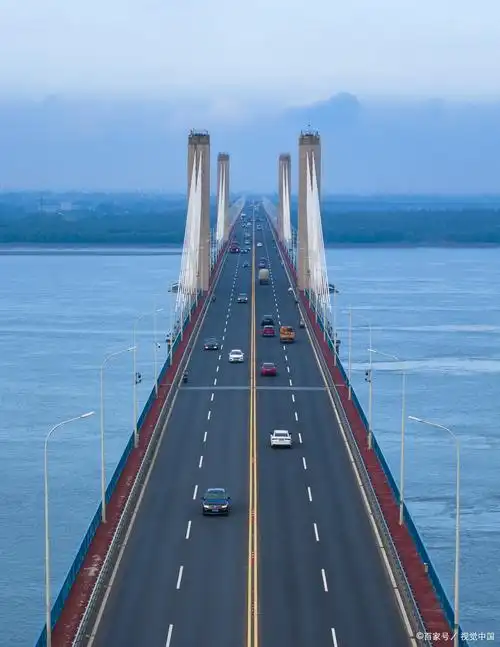
Architecturally, the bridge employs a low-pylon, double-cable-plane, composite-beam cable-stayed design, with a main span of 312 metres and an overall length of roughly 10.5 kilometres carrying both highway and rail traffic. The visual effect is more graphic than elegant—two compact white towers with fanning steel cables, reminiscent of the Severn Bridge family in Britain. Watching a high-speed train glide across the deck while lorries thunder past beneath is the classic Anhui spectacle: a layered choreography of transport modes that captures China's engineering confidence in a single sweeping frame.
Beyond its practical role, the bridge has acquired deep cultural weight as Wuhu's symbolic backbone. Locals speak of it as the structure that finally let Anhui step into the orbit of the Yangtze River Delta megaregion—Shanghai, Nanjing, Hangzhou—dramatically shortening the journey between this once-peripheral province and the economic powerhouse of eastern China. It has become shorthand for regional pride, the steel-and-cable counterpart to the paintings and poetry that have celebrated the Yangtze since the Tang dynasty. For photographers, the bridge is a magnetic subject, especially framed against cargo barges drifting downstream like something from a turn-of-the-century steampaint postcard.
Visitors cannot walk onto the bridge itself—pedestrians and cyclists are strictly prohibited for safety reasons—but several superb viewpoints line the riverbanks. The best is Wuhu Yangtze River Park, whose wooden boardwalks and sunset terrace put you almost at water level looking up at the soaring pylons. The riverside promenade of Binjiang Park offers a slightly different angle, closer to the bridge's northern approach. Plan to arrive by 17:00 in summer for the golden-hour light, when the steel structure glows amber and the river's surface turns to molten bronze. Note that drone flights over the bridge are forbidden, and illumination after dark is limited, so dusk is far better than night for photography.
Make the bridge part of a longer Yangtze Discovery itinerary: stroll the river park at leisure, capture the sunset, then cross into Wuhu's old town for street-food classics like steamed xiaolongbao dumplings and the famous shrimp-topped noodles (xiazi mian). The combination of a twenty-first-century engineering icon with a historic port-city food scene offers something most European capitals cannot—a working bridge that is still changing lives every day, not a museum piece. For travellers interested in modern China beyond the obvious megacities, Wuhu's river and its bridge are a quietly compelling stop.
When Wuhu Yangtze River Bridge opened in September 2000, it ended an era stretching back centuries—when crossing the Yangtze near this stretch of Anhui meant queuing for ferries that were frequently suspended by winter fogs and summer floods. The bridge was a flagship of China's "Ninth Five-Year Plan," the same kind of state-driven industrial ambition that produced Europe's great railway age in the nineteenth century. For Western visitors, the moment is reminiscent of the Tyne Bridge opening in Newcastle or the Forth Road Bridge transforming Scottish life: a piece of steelwork that turns two riverbanks into one community, and a region into a player on the continental stage.
Architecturally, the bridge employs a low-pylon, double-cable-plane, composite-beam cable-stayed design, with a main span of 312 metres and an overall length of roughly 10.5 kilometres carrying both highway and rail traffic. The visual effect is more graphic than elegant—two compact white towers with fanning steel cables, reminiscent of the Severn Bridge family in Britain. Watching a high-speed train glide across the deck while lorries thunder past beneath is the classic Anhui spectacle: a layered choreography of transport modes that captures China's engineering confidence in a single sweeping frame.
Beyond its practical role, the bridge has acquired deep cultural weight as Wuhu's symbolic backbone. Locals speak of it as the structure that finally let Anhui step into the orbit of the Yangtze River Delta megaregion—Shanghai, Nanjing, Hangzhou—dramatically shortening the journey between this once-peripheral province and the economic powerhouse of eastern China. It has become shorthand for regional pride, the steel-and-cable counterpart to the paintings and poetry that have celebrated the Yangtze since the Tang dynasty. For photographers, the bridge is a magnetic subject, especially framed against cargo barges drifting downstream like something from a turn-of-the-century steampaint postcard.
Visitors cannot walk onto the bridge itself—pedestrians and cyclists are strictly prohibited for safety reasons—but several superb viewpoints line the riverbanks. The best is Wuhu Yangtze River Park, whose wooden boardwalks and sunset terrace put you almost at water level looking up at the soaring pylons. The riverside promenade of Binjiang Park offers a slightly different angle, closer to the bridge's northern approach. Plan to arrive by 17:00 in summer for the golden-hour light, when the steel structure glows amber and the river's surface turns to molten bronze. Note that drone flights over the bridge are forbidden, and illumination after dark is limited, so dusk is far better than night for photography.
Make the bridge part of a longer Yangtze Discovery itinerary: stroll the river park at leisure, capture the sunset, then cross into Wuhu's old town for street-food classics like steamed xiaolongbao dumplings and the famous shrimp-topped noodles (xiazi mian). The combination of a twenty-first-century engineering icon with a historic port-city food scene offers something most European capitals cannot—a working bridge that is still changing lives every day, not a museum piece. For travellers interested in modern China beyond the obvious megacities, Wuhu's river and its bridge are a quietly compelling stop.