Dongchang Lake
⭐ 4.20
Dongchang Lake Scenic Area, Dongchang District, Liaocheng City, Shandong Province, China
 Dongchang Lake's history stretches back nearly a millennium to 1070 AD, when Song Dynasty engineers carved this vast reservoir from the Shandong plain. By the Ming and Qing eras, the lake became inseparable from the Grand Canal — the great waterway that, like Venice's network of canals, fueled northern China's commerce. Liaocheng flourished as a critical grain-shipping hub, and the lake served dual purposes: storing water for the canal and defending the old walled city. This dual function mirrors how Bruges and Amsterdam balanced trade with fortification, making Dongchang a living museum of hydraulic and urban ingenuity.
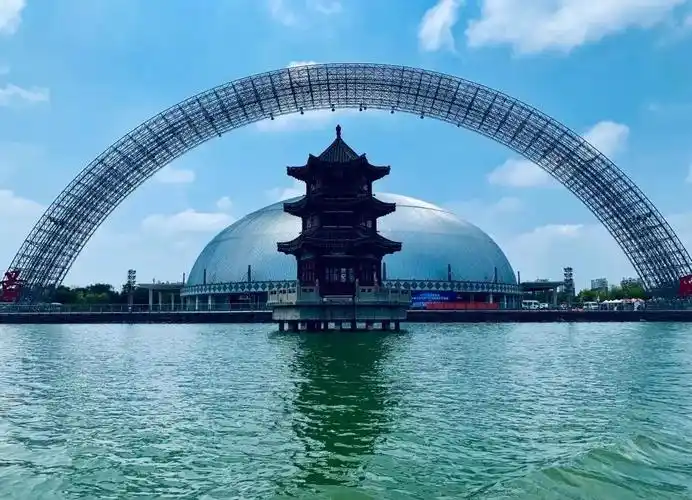
What makes Dongchang Lake genuinely extraordinary is its "city-on-water" configuration — a one-square-kilometre square old town entirely ringed by lake, punctuated by small wooded islands. Floating above the water, the old town resembles Mont-Saint-Michel in Normandy or the watery embrace of Belem Tower in Lisbon, though on a far grander scale. The 600-year-old Light Pavilion (Guangyue Lou) presides over the scene from the southern wall, ranking among China's "Ten Famous Towers" alongside the Yellow Crane Tower and Yueyang Tower. Climb its timber staircases for panoramic views that stretch across lake, canal, and rooftops.
Just steps from the pavilion stands the Shanxi-Shaanxi Guild Hall, a 17th-century merchants' assembly hall whose intricate wood carvings rival the finest European Baroque woodwork in Lübeck or Antwerp. Built by wealthy traders who grew rich on Grand Canal commerce, it remains one of the finest surviving Qing-era guild halls in China. Nearby, the China Grand Canal Culture Museum and the Kong Fansen Memorial Hall provide deeper context — the former tracing the 1,776-kilometre waterway's two-millennia history, the latter honouring a beloved local-born official. Together these sites illuminate the commercial soul of old northern China.
Visiting Dongchang Lake is refreshingly low-cost and unhurried. The park is open free around the clock, with a 15-kilometre lakeside cycling and walking path threading past zodiac-themed plazas, a twenty-one-arch bridge, and a sandy bathing beach. Four-person pedal boats rent for roughly 80 yuan per hour, and an evening light-and-water show can be booked separately. Entry to Guangyue Lou's upper floors and certain museums requires individual tickets. Allow half a day for the highlights or a full day to absorb everything at a leisurely pace — the lake rewards slow exploration.
The golden hours are early morning (6–8 am) and after 5 pm, when soft light paints the water and old city walls glow amber. In summer, avoid the punishing midday sun. Restaurants, parking, and bus connections are all well-developed around the lake's perimeter, and driving from Jinan or Beijing is straightforward. Dongchang Lake is rarely crowded by international standards, offering visitors an unfiltered, atmospheric encounter with a water-bound city that has carried traders, poets, and pilgrims for a thousand years.
Dongchang Lake's history stretches back nearly a millennium to 1070 AD, when Song Dynasty engineers carved this vast reservoir from the Shandong plain. By the Ming and Qing eras, the lake became inseparable from the Grand Canal — the great waterway that, like Venice's network of canals, fueled northern China's commerce. Liaocheng flourished as a critical grain-shipping hub, and the lake served dual purposes: storing water for the canal and defending the old walled city. This dual function mirrors how Bruges and Amsterdam balanced trade with fortification, making Dongchang a living museum of hydraulic and urban ingenuity.
What makes Dongchang Lake genuinely extraordinary is its "city-on-water" configuration — a one-square-kilometre square old town entirely ringed by lake, punctuated by small wooded islands. Floating above the water, the old town resembles Mont-Saint-Michel in Normandy or the watery embrace of Belem Tower in Lisbon, though on a far grander scale. The 600-year-old Light Pavilion (Guangyue Lou) presides over the scene from the southern wall, ranking among China's "Ten Famous Towers" alongside the Yellow Crane Tower and Yueyang Tower. Climb its timber staircases for panoramic views that stretch across lake, canal, and rooftops.
Just steps from the pavilion stands the Shanxi-Shaanxi Guild Hall, a 17th-century merchants' assembly hall whose intricate wood carvings rival the finest European Baroque woodwork in Lübeck or Antwerp. Built by wealthy traders who grew rich on Grand Canal commerce, it remains one of the finest surviving Qing-era guild halls in China. Nearby, the China Grand Canal Culture Museum and the Kong Fansen Memorial Hall provide deeper context — the former tracing the 1,776-kilometre waterway's two-millennia history, the latter honouring a beloved local-born official. Together these sites illuminate the commercial soul of old northern China.
Visiting Dongchang Lake is refreshingly low-cost and unhurried. The park is open free around the clock, with a 15-kilometre lakeside cycling and walking path threading past zodiac-themed plazas, a twenty-one-arch bridge, and a sandy bathing beach. Four-person pedal boats rent for roughly 80 yuan per hour, and an evening light-and-water show can be booked separately. Entry to Guangyue Lou's upper floors and certain museums requires individual tickets. Allow half a day for the highlights or a full day to absorb everything at a leisurely pace — the lake rewards slow exploration.
The golden hours are early morning (6–8 am) and after 5 pm, when soft light paints the water and old city walls glow amber. In summer, avoid the punishing midday sun. Restaurants, parking, and bus connections are all well-developed around the lake's perimeter, and driving from Jinan or Beijing is straightforward. Dongchang Lake is rarely crowded by international standards, offering visitors an unfiltered, atmospheric encounter with a water-bound city that has carried traders, poets, and pilgrims for a thousand years.