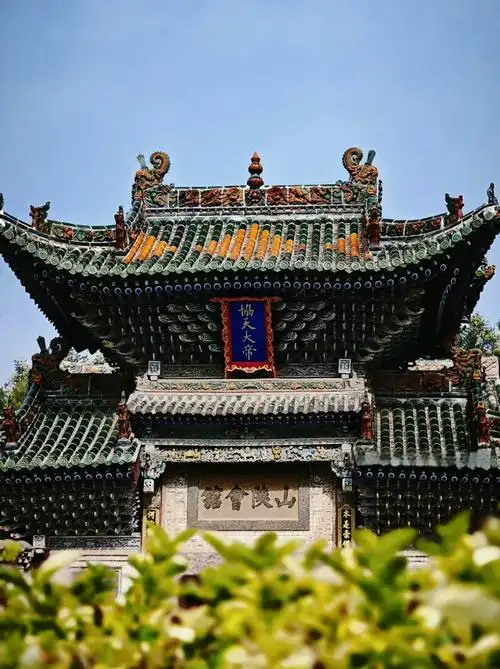
**Historical Context**
The hall was erected in 1776, during the reign of the Qianlong Emperor, the era of China's last great imperial expansion—a period contemporary with Mozart's Vienna and Catherine the Great's St. Petersburg. Wealthy山西(shanxi)、陕西(shanxi), and甘肃(gansu) merchants, much like the Medici of Florence or the Hanseatic traders of Lübeck, pooled their fortunes to build this outpost of provincial loyalty in Kaifeng, then one of China's wealthiest inland trading hubs. Its dual purpose mirrors Europe's medieval guild halls, where commerce met devotion under one roof. Designated a national key cultural relic in 2001, it now functions as the Kaifeng Art Museum, preserving the legacy of these Silk Road-era merchant networks.
**Architecture**
Built on a classical north-south axis following the principles of traditional Chinese siheyuan (courtyard) design, the complex unfolds dramatically from a spirit screen through a theater stage, a spectacular memorial archway, and finally the main hall dedicated to Guan Gong. Flanking the central axis are symmetrical bell and drum towers plus wing galleries. The ancient theater stage is the only surviving Qing-era performance venue in Kaifeng, while the unusual "chicken-claw" six-pillar, five-roof archway is virtually unique in Chinese architecture. The whole ensemble covers roughly 5.8 mu, or about 0.4 hectares, radiating the same dignified proportions one finds in a Venetian palazzo courtyard.
**The Three Carving Masterpieces**
What truly sets this hall apart is its breathtaking triad of brick, stone, and wood sculpture, often compared to the intricate stonework of medieval European cathedrals or the woodcarving of a Bavarian monastery. The wooden eaves of the main hall feature seven-layered openwork carving incorporating perspective techniques reminiscent of Italian Renaissance art, depicting dragons, phoenixes, and nine lions at play. Stone carvings adorn the spirit screen and column bases with raw, muscular energy, while the brickwork on the walls showcases motifs like "dragons presenting longevity" and "loyalty, righteousness, benevolence, and bravery"—virtuoso examples of seamless mortar joints that rival any Flemish masonry.
**Cultural Significance**
This is the only fully preserved Qing-dynasty complex in the Central Plains combining bell-drum towers with an ancient theater stage, making it an irreplaceable record of how merchants, faith, and folk art intertwined in old China. It stands as a tangible witness to Guan Gong worship—a tradition akin to the veneration of patron saints in medieval European trading cities—and to the commercial spirit of the Shanxi merchant guilds, often called the "Jews of the East" for their far-flung trade empires. Scholars consider it a precious living archive for studying regional architecture, carving techniques, and merchant customs.
**Practical Visit Information**
The guild hall sits at No. 85 Xufu Street in Kaifeng's Longting District, just steps from the famous Daxiangguo Temple and an easy walk from other Song-dynasty sites. Admission runs roughly 23–25 yuan (about $3–4 USD). Summer hours run 8:00–18:00, while winter hours shift to 8:00–17:30. Important note: ongoing street construction on Xufu Street may close the original south entrance; visitors should enter via the temporary north-side gate and check navigation apps beforehand. Allow 30 minutes to a full hour, and consider booking an on-site guide to unlock the symbolism carved into every surface. Some interior sections prohibit photography—please observe posted signs.
**Why Visit**
For Western travelers tracing the Silk Road or exploring China beyond the Great Wall and Forbidden City, this hidden gem offers an intimate encounter with the merchant culture that once connected Beijing to Central Asia. Where else can you stand inside a perfectly preserved 18th-century guildhall, gaze up at seven-tiered wooden eaves that rival European Baroque ceilings in complexity, and then stroll ten minutes to a Tang-era Buddhist temple? It is the kind of off-the-beaten-path marvel that rewards curious minds with stories of trade, faith, and craftsmanship stretching across continents.