Guangyue Tower
⭐ 4.50
Guangyue Tower, Dongchangfu District, Liaocheng City, Shandong Province, China
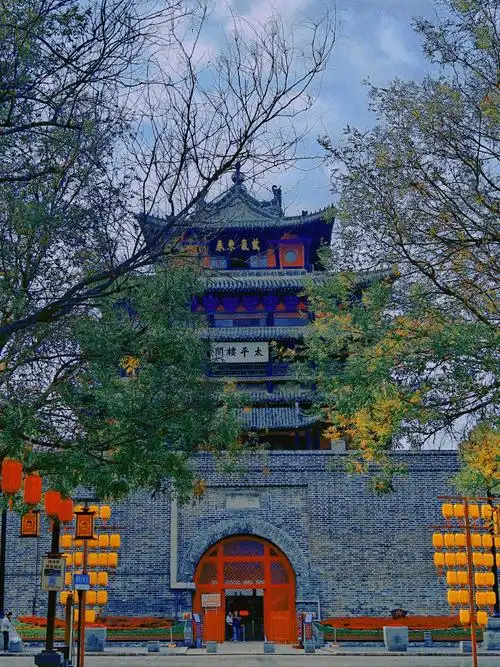 Guangyue Tower was erected in 1374, during the early Ming dynasty under the founding emperor Hongwu—a period roughly contemporary with the early stirrings of the Italian Renaissance. While Europe was still building cathedrals of stone, Chinese craftsmen were perfecting soaring timber towers held together by wooden joints alone, a tradition stretching back over a millennium. The tower gained imperial fame when Emperor Kangxi visited four times and Qianlong six times, leaving behind more than 120 poems and inscriptions. Designated a national key cultural relic in 1988, it ranks among China's "Ten Famous Towers," a distinction roughly analogous to being placed on a list of architectural wonders.
Architecturally, Guangyue is a four-eaved, cross-ridged pavilion tower in the xieshan style, standing 33–34 meters tall (called "nine zhang nine chi" in ancient measurement) on a massive brick platform. Its true marvel lies beneath the surface: 192 wooden pillars, including 32 load-bearing columns that run the building's full height, support more than 200 sets of interlocking bracket sets (dougong) with not a single iron nail. Visitors familiar with half-timbered European churches or Japanese pagodas will recognize a distant cousin in this joinery tradition, though Guangyue represents a transitional style between Song-Yuan elegance and Ming-Qing grandeur. Inside, lotus-patterned caisson ceilings offer both decoration and symbolic fire protection.
Beyond its architectural significance, the tower embodies the commercial and cultural exchange along the Grand Canal, the world's oldest and longest artificial waterway at 1,700 kilometers—predating Europe's great canals by centuries. Inside hang treasured plaques and couplings, including calligraphy by Guo Moruo and an imperial tablet by Kangxi reading "Divine Light Gathering Heroes." Climbing to the top reveals Liaocheng's distinctive "city in the water" layout, with East Chang Lake shimmering around the old quarter—a favorite vantage for photographers seeking that classic Chinese painting composition.
Practical visiting details: Guangyue Tower sits at 28 Loubei Street, Dongchang District. Admission runs about 30 yuan, though combo tickets with the Shanxi-Shaanxi Guild Hall and the county magistrate's office (59–129 yuan) offer better value. Summer hours run 08:00–18:00; winter hours shift to 08:30–17:30. Booking via the official WeChat account "光岳楼1374" is recommended for timed entry. Aim for a 9:00–10:30 AM arrival to beat both crowds and heat, when the light slants beautifully across the lake.
The 112-step staircase is steep and narrow—something to remember if traveling with elderly companions or anyone uneasy with heights. Wear sturdy, non-slip footwear, especially in humid summer months, and bring sun protection or rain gear depending on the season. Please refrain from touching the wooden elements, which have survived since the 1300s and remain remarkably original. Most visitors spend 45 minutes to an hour on-site, but combining the tower with the adjacent Canal Culture Museum, a guild hall visit, and a lake boat ride easily fills a full half-day.
Why visit? In an era when most ancient buildings are reconstructions, Guangyue Tower offers something rare: a genuine handshake with the late medieval world. Where else can you stand inside original Ming timberwork, trace imperial poetry with your eyes, and gaze out over a canal townscape that has changed remarkably little since the days when barges laden with silk and grain passed below? It is an intimate, atmospheric counterpoint to the better-known Great Wall or Forbidden City—quieter, humbler, and all the more memorable for it.
Guangyue Tower was erected in 1374, during the early Ming dynasty under the founding emperor Hongwu—a period roughly contemporary with the early stirrings of the Italian Renaissance. While Europe was still building cathedrals of stone, Chinese craftsmen were perfecting soaring timber towers held together by wooden joints alone, a tradition stretching back over a millennium. The tower gained imperial fame when Emperor Kangxi visited four times and Qianlong six times, leaving behind more than 120 poems and inscriptions. Designated a national key cultural relic in 1988, it ranks among China's "Ten Famous Towers," a distinction roughly analogous to being placed on a list of architectural wonders.
Architecturally, Guangyue is a four-eaved, cross-ridged pavilion tower in the xieshan style, standing 33–34 meters tall (called "nine zhang nine chi" in ancient measurement) on a massive brick platform. Its true marvel lies beneath the surface: 192 wooden pillars, including 32 load-bearing columns that run the building's full height, support more than 200 sets of interlocking bracket sets (dougong) with not a single iron nail. Visitors familiar with half-timbered European churches or Japanese pagodas will recognize a distant cousin in this joinery tradition, though Guangyue represents a transitional style between Song-Yuan elegance and Ming-Qing grandeur. Inside, lotus-patterned caisson ceilings offer both decoration and symbolic fire protection.
Beyond its architectural significance, the tower embodies the commercial and cultural exchange along the Grand Canal, the world's oldest and longest artificial waterway at 1,700 kilometers—predating Europe's great canals by centuries. Inside hang treasured plaques and couplings, including calligraphy by Guo Moruo and an imperial tablet by Kangxi reading "Divine Light Gathering Heroes." Climbing to the top reveals Liaocheng's distinctive "city in the water" layout, with East Chang Lake shimmering around the old quarter—a favorite vantage for photographers seeking that classic Chinese painting composition.
Practical visiting details: Guangyue Tower sits at 28 Loubei Street, Dongchang District. Admission runs about 30 yuan, though combo tickets with the Shanxi-Shaanxi Guild Hall and the county magistrate's office (59–129 yuan) offer better value. Summer hours run 08:00–18:00; winter hours shift to 08:30–17:30. Booking via the official WeChat account "光岳楼1374" is recommended for timed entry. Aim for a 9:00–10:30 AM arrival to beat both crowds and heat, when the light slants beautifully across the lake.
The 112-step staircase is steep and narrow—something to remember if traveling with elderly companions or anyone uneasy with heights. Wear sturdy, non-slip footwear, especially in humid summer months, and bring sun protection or rain gear depending on the season. Please refrain from touching the wooden elements, which have survived since the 1300s and remain remarkably original. Most visitors spend 45 minutes to an hour on-site, but combining the tower with the adjacent Canal Culture Museum, a guild hall visit, and a lake boat ride easily fills a full half-day.
Why visit? In an era when most ancient buildings are reconstructions, Guangyue Tower offers something rare: a genuine handshake with the late medieval world. Where else can you stand inside original Ming timberwork, trace imperial poetry with your eyes, and gaze out over a canal townscape that has changed remarkably little since the days when barges laden with silk and grain passed below? It is an intimate, atmospheric counterpoint to the better-known Great Wall or Forbidden City—quieter, humbler, and all the more memorable for it.