Jianhu Lake
⭐ 4.20
Jianhu Scenic Area, Yuecheng District, Shaoxing City, Zhejiang Province, China
 **Historical Context**
When Ma Zhen completed Jianhu in 140 AD, the Roman Empire still ruled much of Europe and Hadrian's Wall was under construction in northern Britain. Conceived as one of ancient China's earliest large-scale hydraulic engineering projects, the lake once irrigated vast tracts of farmland and supplied drinking water across the Shaoxing plain. Its original surface area rivaled that of Italy's Lake Garda. Ma Zhen was later executed on false charges, but villagers built a shrine in his honor, and his story parallels that of Roman martyr-architects whose public works outlived their persecutors.
**Architecture and Landscape**
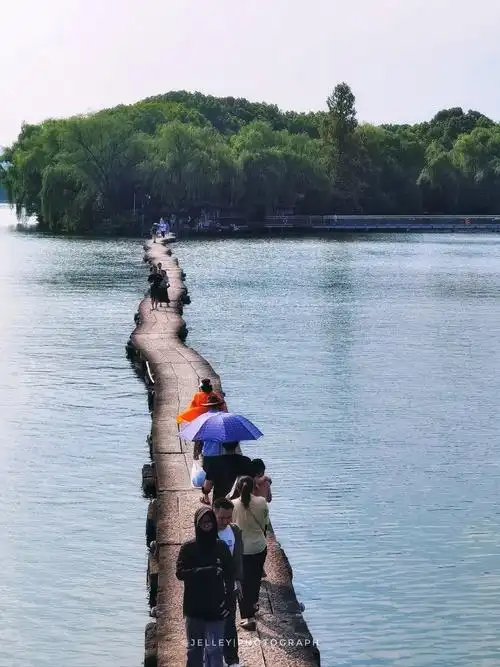
The lake's most striking man-made feature is the 22.5-kilometer ancient towpath, a ribbon of white stone that wends across the water like a Roman viaduct bridging marshland. Walkers and boat passengers trace the same route that for centuries carried trackers hauling cargo vessels. Along the shoreline, the Eastern Han Flute Pavilion marries weathered Han-era structural forms with delicate bamboo craftsmanship, while the Five Bridges Moon-Walking complex strings together a series of arched stone bridges reminiscent of the humpbacked spans found in Venice's quieter canals.
**Cultural Significance**
Jianhu has long been a sanctuary for China's literary elite. Tang dynasty poet Li Bai, Song dynasty master Lu You, and the Tang court scholar He Zhizhang all composed verses while drifting across its waters, embedding the lake into the great tradition of Jiangnan poetry. Its literary pedigree invites comparison to the English Lake District, where Wordsworth and Coleridge likewise transformed a remote landscape into a wellspring of national imagination. Today the lake supplies the irreplaceable mineral water for Shaoxing huangjiu, a rice wine whose production techniques date back over two millennia.
**Visitor Experience**
The lake is not ticketed separately but forms part of the larger Keyan-Jianhu-Luzhen scenic area, with combined admission typically ranging from 120 to 180 yuan. Most visitors enter through the Keyan gate, board a painted pleasure boat, and proceed to the Eastern Han Flute Pavilion, the Five Bridges complex, and Gourd Drunk Island, where a yellow wine museum and a free tasting await. The full circuit, including a return along the towpath, takes between three and five hours. Some boat segments require an additional fee.
**Practical Tips**
Spring and autumn, from March to May and September to November, offer the gentlest light and most photogenic skies. Summer visitors should plan early morning or late afternoon outings to escape the heat and harsh midday glare. Weekday and off-season visits reward photographers with misty, virtually empty shores. Allocate at least half a day and check the weather forecast in advance; sudden rain is common in Zhejiang and can transform the lake into an even more atmospheric scene of silver ripples and drifting clouds.
**Historical Context**
When Ma Zhen completed Jianhu in 140 AD, the Roman Empire still ruled much of Europe and Hadrian's Wall was under construction in northern Britain. Conceived as one of ancient China's earliest large-scale hydraulic engineering projects, the lake once irrigated vast tracts of farmland and supplied drinking water across the Shaoxing plain. Its original surface area rivaled that of Italy's Lake Garda. Ma Zhen was later executed on false charges, but villagers built a shrine in his honor, and his story parallels that of Roman martyr-architects whose public works outlived their persecutors.
**Architecture and Landscape**
The lake's most striking man-made feature is the 22.5-kilometer ancient towpath, a ribbon of white stone that wends across the water like a Roman viaduct bridging marshland. Walkers and boat passengers trace the same route that for centuries carried trackers hauling cargo vessels. Along the shoreline, the Eastern Han Flute Pavilion marries weathered Han-era structural forms with delicate bamboo craftsmanship, while the Five Bridges Moon-Walking complex strings together a series of arched stone bridges reminiscent of the humpbacked spans found in Venice's quieter canals.
**Cultural Significance**
Jianhu has long been a sanctuary for China's literary elite. Tang dynasty poet Li Bai, Song dynasty master Lu You, and the Tang court scholar He Zhizhang all composed verses while drifting across its waters, embedding the lake into the great tradition of Jiangnan poetry. Its literary pedigree invites comparison to the English Lake District, where Wordsworth and Coleridge likewise transformed a remote landscape into a wellspring of national imagination. Today the lake supplies the irreplaceable mineral water for Shaoxing huangjiu, a rice wine whose production techniques date back over two millennia.
**Visitor Experience**
The lake is not ticketed separately but forms part of the larger Keyan-Jianhu-Luzhen scenic area, with combined admission typically ranging from 120 to 180 yuan. Most visitors enter through the Keyan gate, board a painted pleasure boat, and proceed to the Eastern Han Flute Pavilion, the Five Bridges complex, and Gourd Drunk Island, where a yellow wine museum and a free tasting await. The full circuit, including a return along the towpath, takes between three and five hours. Some boat segments require an additional fee.
**Practical Tips**
Spring and autumn, from March to May and September to November, offer the gentlest light and most photogenic skies. Summer visitors should plan early morning or late afternoon outings to escape the heat and harsh midday glare. Weekday and off-season visits reward photographers with misty, virtually empty shores. Allocate at least half a day and check the weather forecast in advance; sudden rain is common in Zhejiang and can transform the lake into an even more atmospheric scene of silver ripples and drifting clouds.