Bazi Bridge
⭐ 4.20
Bazi Bridge Street, Yuecheng District, Shaoxing City, Zhejiang Province, China
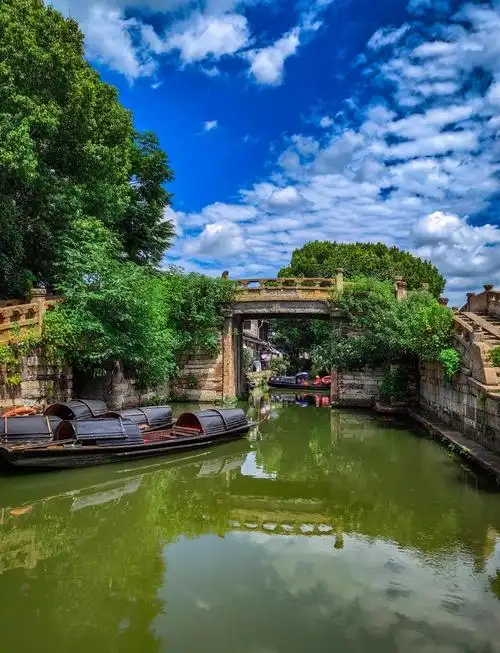 Bazi Bridge was first erected during the Jiatai reign of the Southern Song dynasty (1201–1204) and rebuilt in 1256, making it contemporary with the final chapters of the Crusades and the drafting of the Magna Carta. Standing where three waterways meet, it was part of the vast inland navigation network that, like Europe's Rhine and Danube corridors, carried grain, silk, and imperial tribute across the empire. Inscribed as a national key cultural relic in 2001 and incorporated into UNESCO's Grand Canal World Heritage Site, the bridge has watched eight centuries of canal commerce, waterborne festivals, and quiet neighborhood routines unfold beneath its spans.
The structure is a stone-beam bridge comprising two arms set diagonally in a "八" character—literally the Chinese word for "eight"—creating three-way sloping approaches that link four streets across three canals. The pioneering scholar of Chinese architecture Chen Congzhou famously hailed it as "the country's earliest urban grade-separated interchange," anticipating the multi-level road junctions of the modern world by some seven centuries. From the deck, the three-river confluence spreads out below, with slim wooden boats gliding through channels framed by whitewashed houses with dark tile roofs.
Beyond its engineering pedigree, Bazi Bridge is a rare surviving slice of living Song-era urbanism. The surrounding alleyways retain their medieval grid, and residents still draw water, hang laundry, and chat on the stone steps exactly as their ancestors did. This "neighborhood rather than tourist attraction" quality makes the site invaluable to scholars of Southern Song market culture and Jiangnan settlement patterns—a humbler but more intimate parallel to Venice's everyday canals or Amsterdam's Jordaan district.
Visiting is straightforward: entry is free and the bridge is open around the clock. The address is the eastern end of Bazi Bridge Straight Street, Yuecheng District, Shaoxing, Zhejiang. Take bus 8, 21, 22, 25, or 31 to the "Maternal and Child Health Hospital" stop, or walk roughly fifteen minutes from the Lu Xun Native Place museum. Plan 15–30 minutes to view the bridge itself, or 1–2 hours to wander the surrounding lanes and link it into a compact heritage loop with Guangning Bridge, Longhua Temple, and Cangqiao Straight Street.
Aim for early morning or late afternoon, when soft light gilds the tiles and residents are most likely to be doing their washing by the river—an encounter more memorable than any staged performance. Note that this is a residential zone: keep voices low, do not enter private homes, and always ask permission before photographing locals. Summer midday sun is intense and some sections show restoration scarring, so bring sunscreen, water, and a relaxed pace. Come for the ingenious "interchange," but stay for the unhurried poetry of a canal town that has barely changed since Marco Polo's era.
Bazi Bridge was first erected during the Jiatai reign of the Southern Song dynasty (1201–1204) and rebuilt in 1256, making it contemporary with the final chapters of the Crusades and the drafting of the Magna Carta. Standing where three waterways meet, it was part of the vast inland navigation network that, like Europe's Rhine and Danube corridors, carried grain, silk, and imperial tribute across the empire. Inscribed as a national key cultural relic in 2001 and incorporated into UNESCO's Grand Canal World Heritage Site, the bridge has watched eight centuries of canal commerce, waterborne festivals, and quiet neighborhood routines unfold beneath its spans.
The structure is a stone-beam bridge comprising two arms set diagonally in a "八" character—literally the Chinese word for "eight"—creating three-way sloping approaches that link four streets across three canals. The pioneering scholar of Chinese architecture Chen Congzhou famously hailed it as "the country's earliest urban grade-separated interchange," anticipating the multi-level road junctions of the modern world by some seven centuries. From the deck, the three-river confluence spreads out below, with slim wooden boats gliding through channels framed by whitewashed houses with dark tile roofs.
Beyond its engineering pedigree, Bazi Bridge is a rare surviving slice of living Song-era urbanism. The surrounding alleyways retain their medieval grid, and residents still draw water, hang laundry, and chat on the stone steps exactly as their ancestors did. This "neighborhood rather than tourist attraction" quality makes the site invaluable to scholars of Southern Song market culture and Jiangnan settlement patterns—a humbler but more intimate parallel to Venice's everyday canals or Amsterdam's Jordaan district.
Visiting is straightforward: entry is free and the bridge is open around the clock. The address is the eastern end of Bazi Bridge Straight Street, Yuecheng District, Shaoxing, Zhejiang. Take bus 8, 21, 22, 25, or 31 to the "Maternal and Child Health Hospital" stop, or walk roughly fifteen minutes from the Lu Xun Native Place museum. Plan 15–30 minutes to view the bridge itself, or 1–2 hours to wander the surrounding lanes and link it into a compact heritage loop with Guangning Bridge, Longhua Temple, and Cangqiao Straight Street.
Aim for early morning or late afternoon, when soft light gilds the tiles and residents are most likely to be doing their washing by the river—an encounter more memorable than any staged performance. Note that this is a residential zone: keep voices low, do not enter private homes, and always ask permission before photographing locals. Summer midday sun is intense and some sections show restoration scarring, so bring sunscreen, water, and a relaxed pace. Come for the ingenious "interchange," but stay for the unhurried poetry of a canal town that has barely changed since Marco Polo's era.