Shaoxing Grand Theatre
⭐ 3.20
No. 258, Lu Xun Middle Road, Yuecheng District, Shaoxing City, Zhejiang Province, China
 Shaoxing, whose canals and stone bridges reflect more than two and a half millennia of continuous habitation, has long stood among China's most cultured cities. It is famed as the birthplace of Lu Xun, the towering figure of modern Chinese literature, and of Wang Xizhi, whose 4th-century calligraphy remains a touchstone across East Asia. Comparable in cultural pedigree to Salzburg or Stratford-upon-Avon—the hometowns of Mozart and Shakespeare respectively—Shaoxing is also the cradle of Yueju opera, one of China's most lyrical regional theatrical forms. Opened in the early 2000s, the Grand Theatre was conceived as the city's flagship stage, anchoring its cultural life much as the Festspielhaus anchors Austria's musical identity.
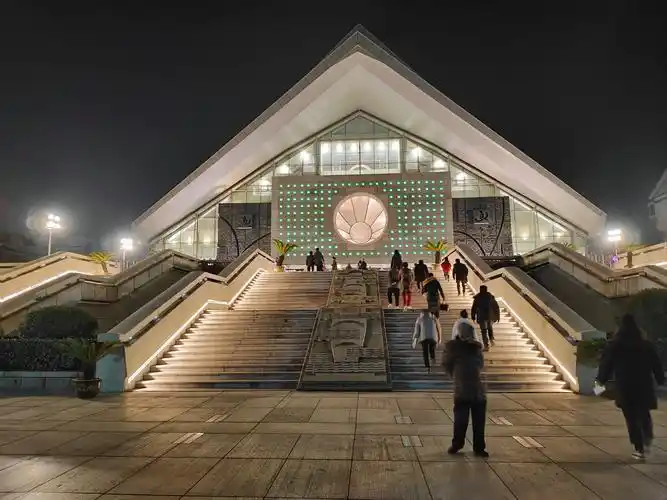
The building's design, by Shanghai-based architect Cai Zhenyu, draws its inspiration from the wupeng boat—the slender black-canopied skiff that has plied Shaoxing's waterways for centuries. The exposed steel frame sweeps upward in a bold curve, suggesting both a wind-filled sail and the upturned prow of a vessel in motion. The result recalls contemporary European cultural icons such as the Oslo Opera House or London's Barbican Centre, where raw industrial materials are softened into expressive, sculptural form. From the surrounding City Square, the theatre's flowing lines stand in graceful contrast to the more restrained historic fabric nearby.
Inside, the 1,349-seat auditorium—857 on the main floor, 472 in the balcony, and 20 in private boxes—follows the classical horseshoe configuration familiar to visitors of La Scala or London's Royal Opera House. The "pin"-shaped proscenium stage measures 17 meters wide and 10.6 meters high, fitted with elevating and revolving platforms and international-standard lighting and sound systems. This flexibility allows the venue to mount anything from full-scale ballet and symphonic concerts to intimate Yueju dramas, conferences, and film galas. Past events include the World Choir Games and the China Yueju Arts Festival, cementing the theatre's role as a regional powerhouse for the performing arts.
Located at 375 Jiefang North Road in the Yuecheng District, the theatre sits beside the central City Square, roughly 350 meters on foot from Exit F of the nearest metro station. Tickets can be purchased in advance through Damai, Maoyan, or the theatre's official channels. Most evening performances begin at 19:30, and visitors are advised to arrive 30 to 45 minutes early to collect tickets and settle in. During major festivals, expect a livelier international program; in quieter weeks, the schedule often features beloved Yueju classics. Note that the air-conditioning runs strong, so a light jacket is recommended.
As with any traditional theatre, etiquette is observed: silence mobile phones, refrain from photography during performances, and applaud generously at curtain call. Smart-casual attire is appropriate—flip-flops and shorts are best avoided. After an evening show, the surrounding historic districts of Cangqiao Straight Street and Shusheng Guli (the "Hometown of the Sage of Calligraphy") remain lively well into the night, offering the chance to sample local specialties such as huangjiu (yellow rice wine) popsicles or a leisurely ride on an illuminated wupeng boat along the canals—completing a cultural evening that bridges stage performance and living heritage.
Shaoxing, whose canals and stone bridges reflect more than two and a half millennia of continuous habitation, has long stood among China's most cultured cities. It is famed as the birthplace of Lu Xun, the towering figure of modern Chinese literature, and of Wang Xizhi, whose 4th-century calligraphy remains a touchstone across East Asia. Comparable in cultural pedigree to Salzburg or Stratford-upon-Avon—the hometowns of Mozart and Shakespeare respectively—Shaoxing is also the cradle of Yueju opera, one of China's most lyrical regional theatrical forms. Opened in the early 2000s, the Grand Theatre was conceived as the city's flagship stage, anchoring its cultural life much as the Festspielhaus anchors Austria's musical identity.
The building's design, by Shanghai-based architect Cai Zhenyu, draws its inspiration from the wupeng boat—the slender black-canopied skiff that has plied Shaoxing's waterways for centuries. The exposed steel frame sweeps upward in a bold curve, suggesting both a wind-filled sail and the upturned prow of a vessel in motion. The result recalls contemporary European cultural icons such as the Oslo Opera House or London's Barbican Centre, where raw industrial materials are softened into expressive, sculptural form. From the surrounding City Square, the theatre's flowing lines stand in graceful contrast to the more restrained historic fabric nearby.
Inside, the 1,349-seat auditorium—857 on the main floor, 472 in the balcony, and 20 in private boxes—follows the classical horseshoe configuration familiar to visitors of La Scala or London's Royal Opera House. The "pin"-shaped proscenium stage measures 17 meters wide and 10.6 meters high, fitted with elevating and revolving platforms and international-standard lighting and sound systems. This flexibility allows the venue to mount anything from full-scale ballet and symphonic concerts to intimate Yueju dramas, conferences, and film galas. Past events include the World Choir Games and the China Yueju Arts Festival, cementing the theatre's role as a regional powerhouse for the performing arts.
Located at 375 Jiefang North Road in the Yuecheng District, the theatre sits beside the central City Square, roughly 350 meters on foot from Exit F of the nearest metro station. Tickets can be purchased in advance through Damai, Maoyan, or the theatre's official channels. Most evening performances begin at 19:30, and visitors are advised to arrive 30 to 45 minutes early to collect tickets and settle in. During major festivals, expect a livelier international program; in quieter weeks, the schedule often features beloved Yueju classics. Note that the air-conditioning runs strong, so a light jacket is recommended.
As with any traditional theatre, etiquette is observed: silence mobile phones, refrain from photography during performances, and applaud generously at curtain call. Smart-casual attire is appropriate—flip-flops and shorts are best avoided. After an evening show, the surrounding historic districts of Cangqiao Straight Street and Shusheng Guli (the "Hometown of the Sage of Calligraphy") remain lively well into the night, offering the chance to sample local specialties such as huangjiu (yellow rice wine) popsicles or a leisurely ride on an illuminated wupeng boat along the canals—completing a cultural evening that bridges stage performance and living heritage.